By Kirubel Tesfaye
Claim
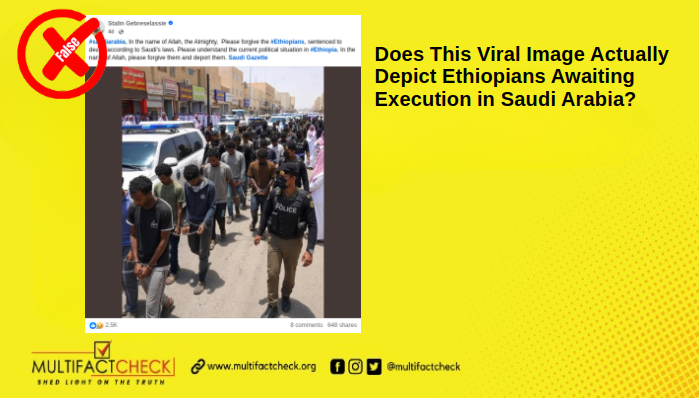
Stalin Gebreselassie, a journalist and activist, shared a post with an image. He has more than 350,000 followers. His caption reads: “Saudi Arabia, in the name of Allah, the Almighty, please forgive the Ethiopians sentenced to death according to Saudi laws. Please understand the current political situation in Ethiopia. In the name of Allah, please forgive them and deport them.”
Other accounts then joined the chorus. They used different images to spread a similar story. These posts claim that 65 Ethiopian refugees face imminent execution in Saudi Arabia. According to the posts, these individuals committed only non-violent offenses. Some of them allegedly survived the Tigray war.
By the time of this publication, multiple Facebook and X pages had shared the post. These pages actively support the claimant’s narrative.
Verdict
The image shared alongside the claim is false. It also misrepresents the real situation of Ethiopians facing execution in Saudi Arabia. MFC’s investigation tested the authenticity of this viral image. The results are clear: the picture does not show Ethiopians awaiting execution in Saudi Arabia.
Investigation & Findings
MFC conducted a digital investigation using several open-source techniques. Our goal was to verify the image’s credibility. What we found was a damning body of evidence.

The image displays classic structural failures. These failures are typical of synthetic media generation. A forensic look at the mid-ground reveals more problems. The handcuffs and chains lack physical integrity. In some areas, the metal links appear to melt. Some alleged detainees wear unfastened or free handcuffs. Chain segments frequently break or simply disappear into thin air.
Anatomical distortions are also prevalent. This is especially true for the detainees in the foreground. Multiple unnatural hands appear on a single body. Furthermore, the text on the guard’s tactical vest reads “EGNIIS POLICE.” This is a nonsensical department name. The font is inconsistent and warped. Such errors reflect an AI’s struggle with precise typography.

The background reveals even more flaws. The mob wearing hijabs contains figures whose bodies appear melted. Pseudo-Arabic script adorns the scene. The crowd then dissolves into a soup of indistinguishable, blurred figures. These figures lack distinct facial features or body shapes. Finally, we notice unnaturally smooth, waxy skin textures and flat lighting. Taken together, these anomalies prove the image is a synthetic fabrication, not a genuine photograph.
Our fact-checking team additionally employed the Hugging Face AI Image Detector to assess if the image captured an authentic event or originated from artificial intelligence. The tool indicated a 100 percent probability that the image was synthetically produced.

Context
The false claim did not emerge from a vacuum. In early 2026, Human Rights Watch published a troubling report. That report confirmed that at least 65 Ethiopian migrants in Saudi Arabia face imminent execution. Their alleged crimes are non-violent drug offenses. This news followed the execution of three other Ethiopians in April 2026.
Many of these individuals are legitimate refugees. They originally fled the devastating Tigray conflict. Smugglers then allegedly coerced them into carrying khat. Khat is a stimulant. It remains legal in Ethiopia but is strictly banned in Saudi Arabia. These migrants were simply seeking work. Instead, they became entangled in a harsh legal system.
Human rights advocates report a systematic lack of due process. Detainees often receive only brief group hearings. They have no legal representation and no translators. Authorities rarely provide clear notification of charges. Many detainees are forced to sign documents they cannot read or understand. This treatment fuels genuine fear and online outrage, making false claims like the viral image more believable to an unsuspecting public.
Meanwhile, Saudi Arabia’s use of capital punishment has escalated sharply. Executions temporarily declined during the pandemic. Then, in 2024, the kingdom carried out 345 executions, a record at the time. Saudi Arabia surpassed that grim milestone in 2025 with 356 confirmed cases. The primary driver was a 2022 decision to lift a moratorium on the death penalty for drug offenses. This policy has disproportionately targeted foreign nationals. International monitors continue to report secret trials and no access to legal counsel.
Conclusion
The image does not show Ethiopians awaiting execution. A detail-oriented investigation proved that fact. Instead, MFC’s investigation confirms the image is AI-generated user content. The viral post therefore misleads the public by pairing a real humanitarian crisis with a fabricated visual. This distortion harms genuine advocacy efforts. It also erodes trust in legitimate reports of human rights abuses. Consequently, MFC rates this claim as false.
Reader Alert & Advice: We urge our readers to stay vigilant: never share sensational images without verification. Bad actors exploit real tragedies with fake visuals to inflame emotions and spread lies. So remain skeptical of emotionally charged content. Before sharing, pause and investigate. Verify claims through multiple reputable sources. Reverse-search suspicious images. Check with established fact-checkers. This protects you and others from becoming links in the chain of disinformation.