
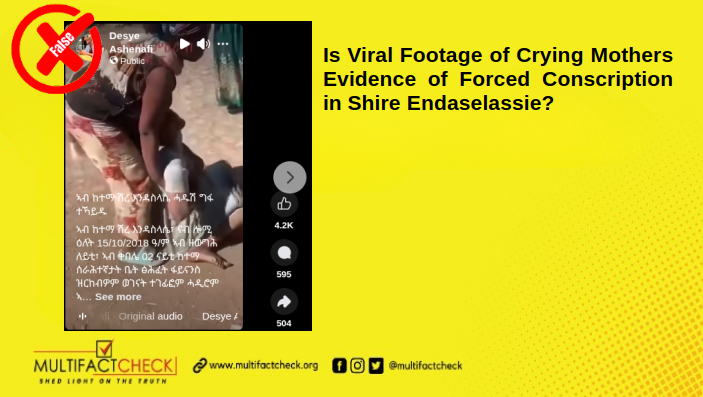
The Claim
A Facebook user shared a video clip claiming to show a recent incident of forced conscription in Shire Endaselassie, Tigray. The post, captioned in Tigrinya, “A new round of forced conscription has taken place in the city of Shire Endaselassie”, features sensitive content showing Tigrayan mothers crying in public.
Verdict
The video clip is not recent, nor does it depict an event from June 22, 2026. Our investigation confirms that this footage first appeared online approximately a year and a half ago, in January 2025—well before the claimed date. Consequently, the video cannot serve as evidence of the recent conscription wave that began around May 2026.
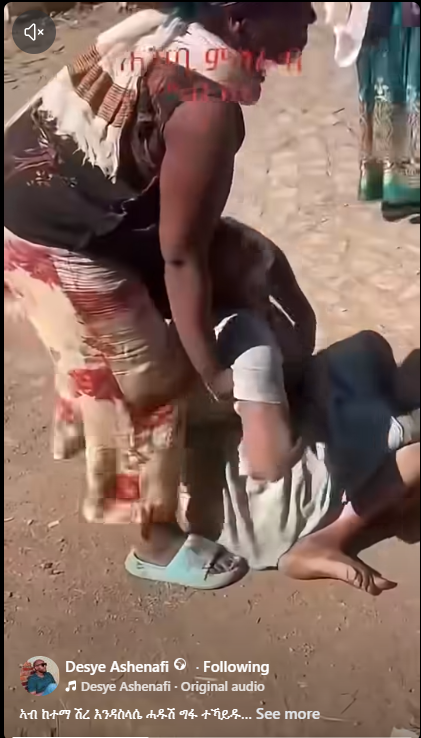
Image 1: A screenshot of the Facebook post containing the claim
The account that shared the reel, which has more than 205,000 followers, claimed the incident occurred on June 22, 2026 (15/10/2018 in the Ethiopian calendar). The post further suggested that the footage, showing Tigrayan mothers crying publicly in apparent grief and helplessness, is connected to a recent wave of forced youth conscription in the Tigray region. The video gained significant traction, accumulating over 4,200 engagements and more than 125,000 views by the time this report was published.
Several other Facebook users independently shared the same footage of a recent incident, using different captions but conveying similar claims. (Links: here , here , and here .)
Investigation & Findings
The MFC team launched an investigation to verify the authenticity and timeline of a video clip that had recently resurfaced in connection with claims about forced conscription in Tigray. Given the sensitive nature of the ongoing situation, where media reports indicate that such conscription incidents only began around May 2026, the team aimed to determine whether the footage was genuinely contemporary or had been misleadingly repurposed. To conduct this digital forensic analysis, the team employed a combination of video keyframe extraction and reverse image search techniques to trace the earliest known appearance of the visual material online.
As a first technical step, the MFC team utilized the InVID Chrome extension, a widely used verification tool, to extract a series of distinct keyframes from the video clip in question. These keyframes represent static snapshots of the most significant visual moments within the footage, allowing for more precise and manageable reverse searches than querying the video as a whole. After isolating several high-quality frames, the team proceeded to run each one through Google’s reverse image search engine, systematically checking for any prior indexed instances of the same or visually similar images across the web.
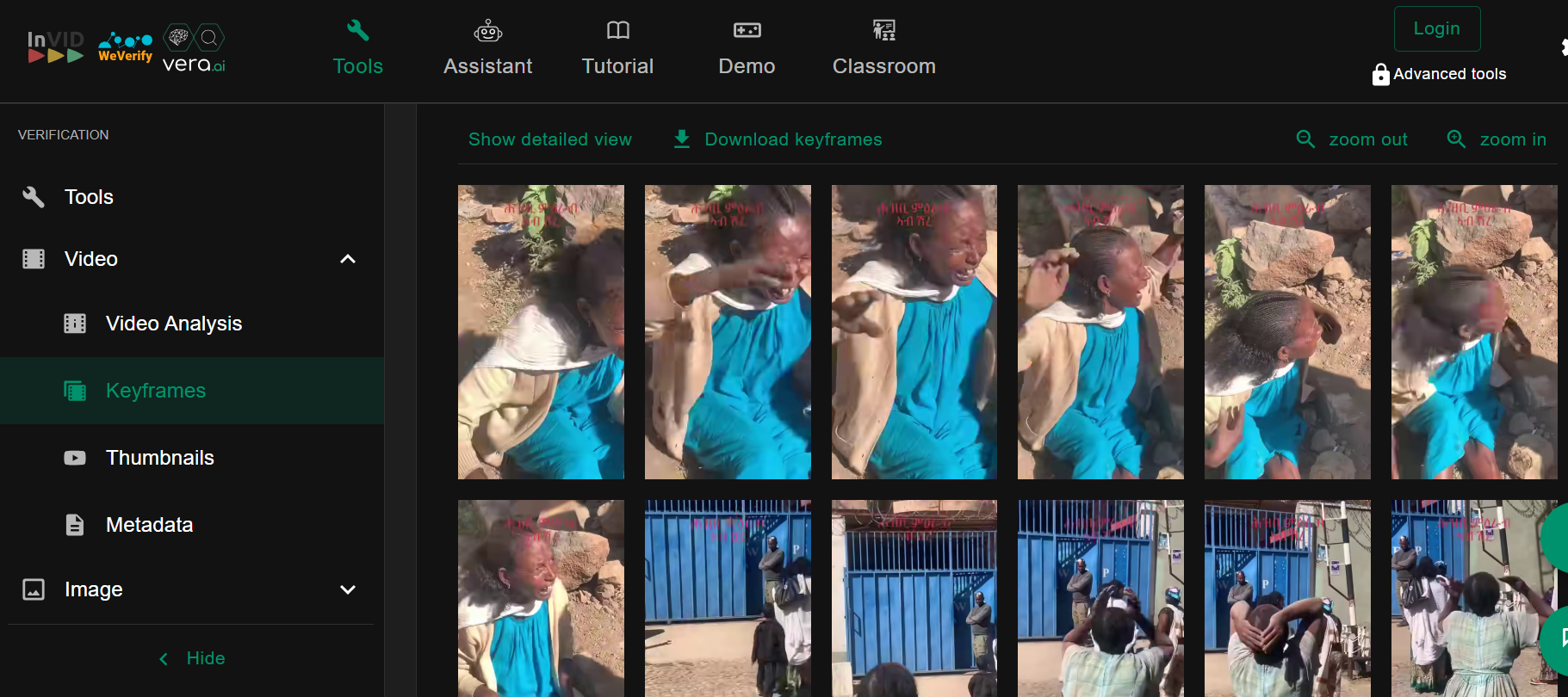
Image 2: Screenshot taken from Invid keyframe result
The reverse image search results yielded a clear and conclusive finding: the earliest traceable publication of this video dates back to approximately a year and a half ago, specifically January 2025 —well before the May 2026 timeframe associated with the recent forced conscription reports. Crucially, the original posts from that earlier period did not reference military conscription at all; instead, they were framed as depicting the suffering of Tigrayan mothers under what was described as local administrative oppression. This temporal discrepancy strongly suggests that the current circulation of the footage is a case of miscontextualization, wherein old imagery is being recirculated to support a narrative that does not align with its original or documented context.

Image 3: MFC used this keyframe from the footage and applied Google reverse image search
Context
Since May 2026, multiple media outlets have reported on alleged forced conscriptions of young people emerging from various parts of Tigray. Residents, opposition political groups, and human rights organizations have warned of growing fear and tension in the region, amid concerns over the possibility of renewed armed conflict.
Regional authorities have also taken legislative steps that have drawn sharp criticism. A controversial draft proclamation recently approved by the Tigray People’s Liberation Front (TPLF) in the Tigray regional state has been condemned by opposition political parties, who accuse the TPLF of using the law to suppress dissent, restrict free expression, and provide legal cover for the forced mobilization of youth.
Human Rights Watch has separately called on Tigray authorities to repeal the law, which the organization says enables forced mobilization and punishes dissent.
Against this backdrop of credible reporting and growing public concern, social media users from Tigray have been sharing video clips purporting to document the situation on the ground. The claim examined in this report circulated within that same context, which likely contributed to its rapid spread.
Conclusion
While multiple reports from media outlet and human rights organizations confirm that forced conscription by Tigray officials is an ongoing and documented concern, the specific claim fact-checked here is not connected to any recent incident. The video does not depict an event from June 2026 as stated; a reverse image search confirms it has been available online for at least a year and a half. MFC therefore rates this claim as FALSE.