
By Naol Kenie
Claim
A graphic image circulates rapidly across social media platforms. It shows a man suspended from a wooden beam. Rope binds his wrists and ankles. Some users call the man a priest. One narrative blames Fano forces for the act. Another narrative blames Ethiopian government forces. Both sides claim the victim is an Amhara priest.
Verdict
FALSE. The image is AI-generated. It has no verifiable connection to either narrative. No evidence links this image to Fano forces. Likewise, no proof ties it to Ethiopian government forces. Nor does any confirmation establish that a priest is involved. The image depicts no real event.

Investigation and Findings
Beginning on May 6, 2026, a graphic image spread quickly on social media. It appeared primarily on Facebook (see links here, here, and here). It also spread on X/Twitter (see links here, here, here, and here).
What the Image Actually Shows
The image shows a man hanging from a wooden beam. Rope binds his wrists and ankles. His body hangs in a stress position called “strappado.” This method uses body weight to create tension on shoulders and joints. The international community recognizes this as a form of torture. The image is highly graphic. The active conflict in Ethiopia’s Amhara region makes it emotionally provocative. Consequently, the image became highly shareable.
Two Conflicting Narratives Emerge
Social media users spread the image with opposing captions:
Narrative A: This claims the Ethiopian government forces committed the atrocity. This includes the Ethiopian National Defense Force or affiliated militias. The alleged victim is an Amhara priest.
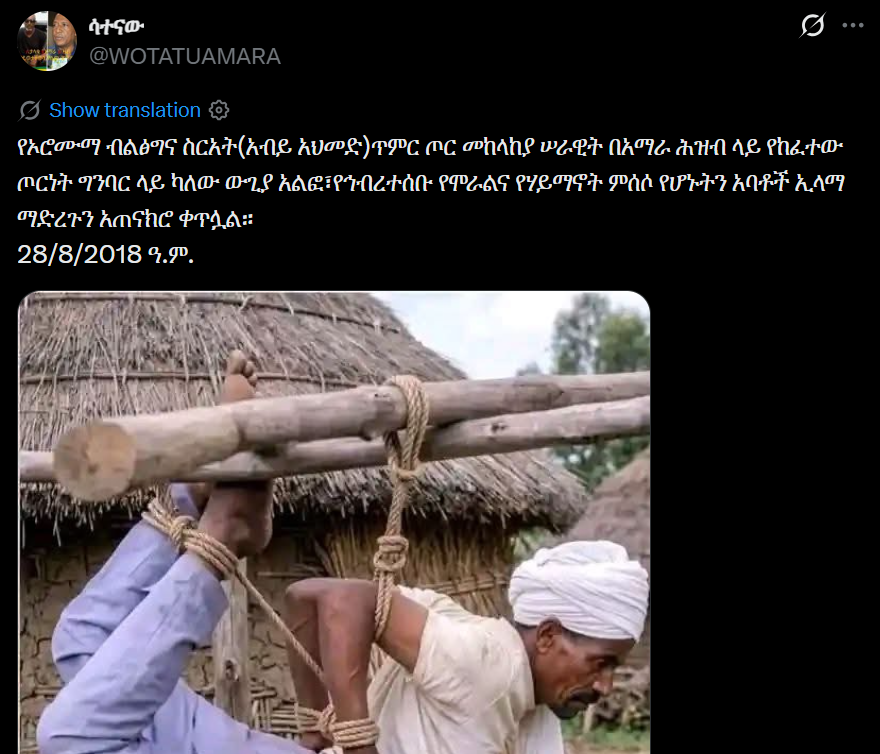
Narrative B: On the other hand, this one claims the Fano forces committed the same act. Fano is an Amhara irregular armed group. This group has fought government forces since 2023.
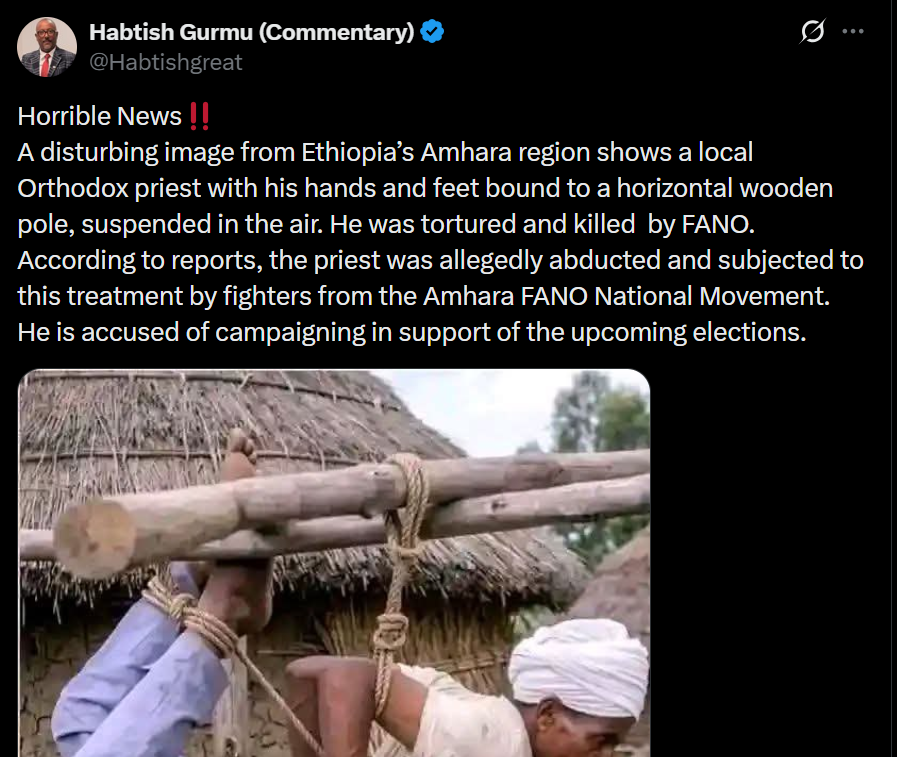
These competing narratives follow a known pattern. Information warfare is common in the Ethiopian conflict. Opposing sides routinely weaponize graphic or manipulated visuals. They use these visuals to advance political or military narratives.
Digital Verification Methods
MFC used multiple digital investigation techniques. We applied open-source intelligence (OSINT) methods and assessed the image’s authenticity carefully. AI-generated imagery has grown increasingly sophisticated. Therefore, our team ran the image through four AI-detection tools: AI or Not, Decopy AI, Hugging Face AI Image Detector, and Hive Moderation.
The results were consistent across all four tools:
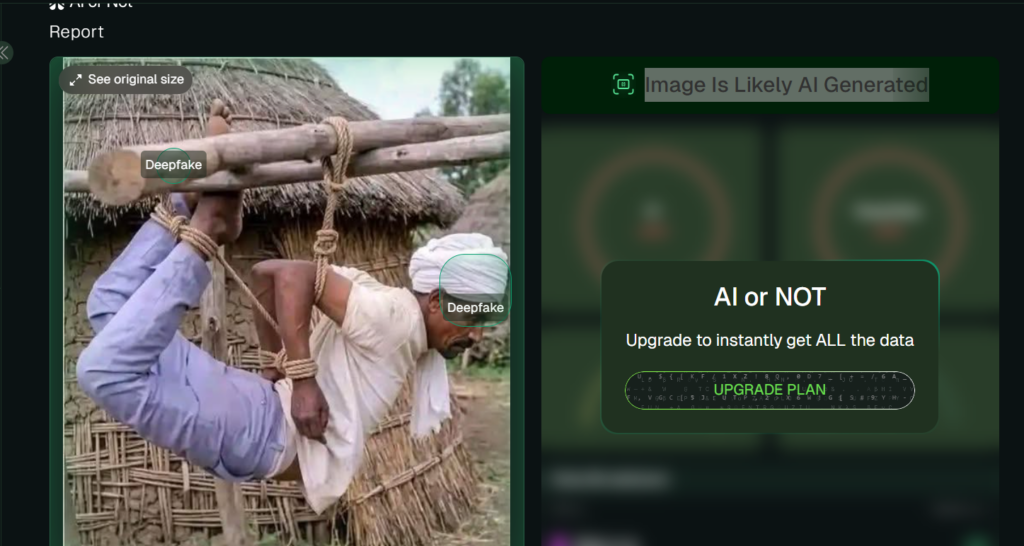
1. AI or Not
This detection tool reported the image as “Likely AI-Generated.” Consequently, the tool found no evidence of an authentic photograph.
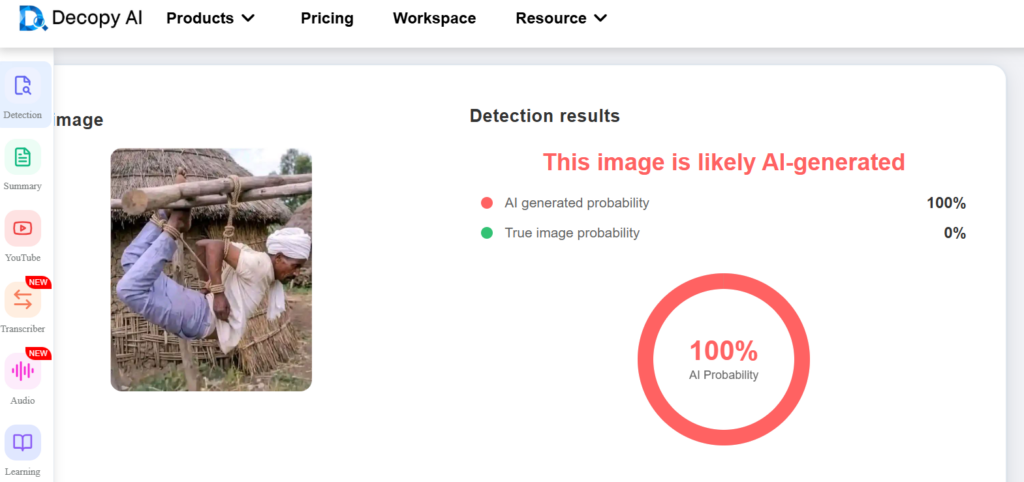
2. Decopy AI
Decopy AI returned a 100% likelihood that the image is AI-generated. In other words, the tool detected no trace of human capture.
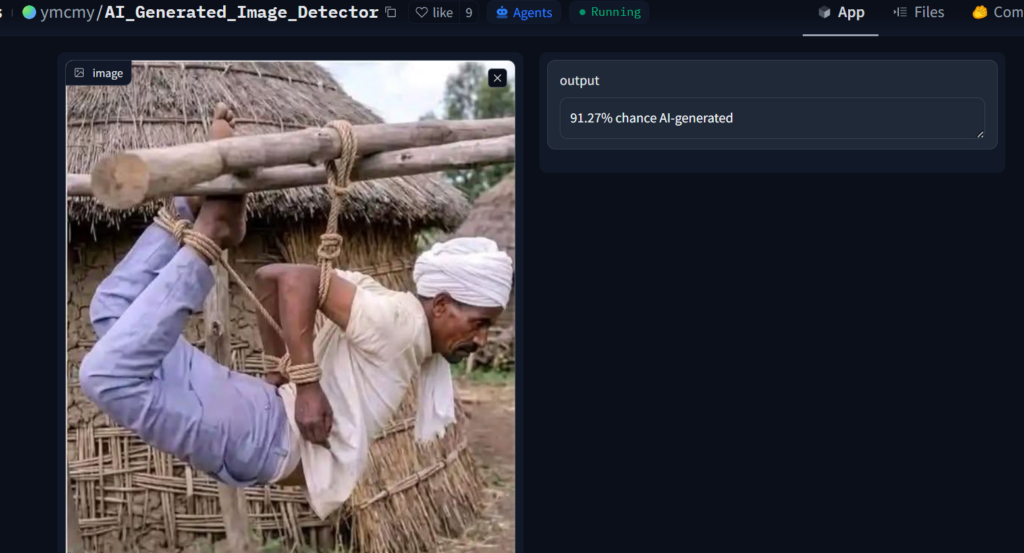
3. Hugging Face AI Image Detector
Likewise, this AI image detector assigned a 91.27% probability of AI generation. Thus, the model strongly rejected any connection to a real camera.
4. Hive Moderation
Lastly, Hive Moderation rated the image as 99.9% likely AI-generated. Accordingly, the tool confirmed with near certainty that no real event was depicted.
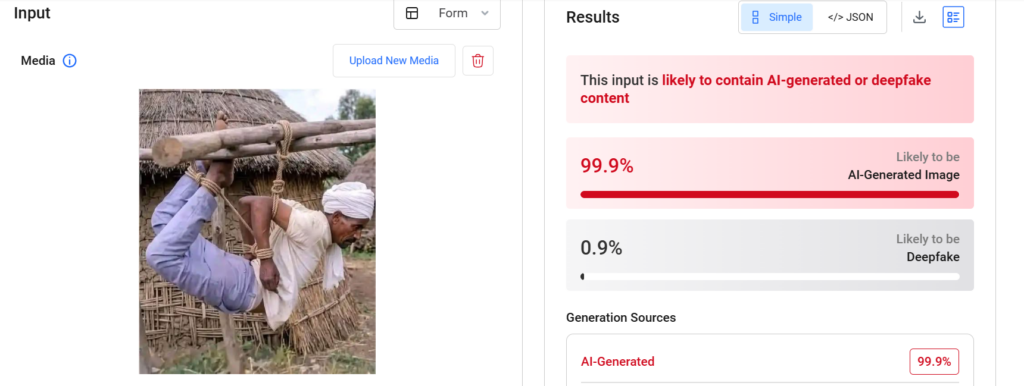
These converging results provide overwhelming evidence. The image was not captured by any camera. No human observer took this photograph. Instead, an AI image-generation system produced it. Consequently, the image does not depict any real event, real person, or real location.
Context
The Amhara Region Conflict and Its Information Landscape
Understanding the political context is essential. Since August 2023, Ethiopia’s federal government has fought Fano. Fano is an Amhara irregular militia. Interestingly, Fano previously allied with federal forces during the Tigray War (2020–2022). Tensions escalated when the federal government attempted to disarm regional special forces.
The government also tried to integrate allied militia groups under a national command structure. Fano fighters viewed this as an attack on Amhara political autonomy. Many in the Amhara community shared this view. Fighting has since spread across multiple zones. These zones include Gondar, Wollo, Gojjam, and Shewa. Consequently, significant civilian displacement has occurred. Casualties have mounted. Humanitarian needs have grown.
An information vacuum creates fertile ground for misinformation. Unverified content spreads easily. Manipulated content spreads effortlessly. Entirely fabricated content also spreads rapidly. Actors on all sides exploit this vacuum. They shape both domestic and international narratives.
Religious Symbolism and Deliberate Targeting of Content
The image’s specific framing carries heavy symbolic weight. It depicts a priest in a position of torture. The Ethiopian Orthodox Tewahedo Church holds enormous cultural authority. This authority is especially strong among the Amhara population. Clergy are revered figures. Therefore, fabricated imagery of violence against priests is powerfully effective. It generates outrage, fuels recruitment, and attracts international sympathy.
The Rise of AI-Generated Conflict Imagery
Accessible AI image-generation tools have spread widely. These tools have lowered the barrier for creating convincing violent imagery. Conflict-zone disinformation campaigns now exploit these tools frequently. They fabricate “evidence” of atrocities, invent human rights abuses, and create false battlefield developments.
AI-generated images differ from traditional photo manipulation. They leave no digital trace of an original photograph. There is no EXIF data to examine, no original source image to trace, and no photographer to contact for verification. This lack of metadata makes debunking difficult. Conventional reverse-image search alone cannot detect them. Consequently, specialized AI-detection tools have become essential in modern fact-checking.
The image in this investigation shows common AI-generated hallmarks. The lighting is hyper-realistic but lacks natural inconsistencies. Skin textures appear slightly unnatural. The overall composition feels staged rather than candid.
Why Scrutinize Both Narratives Against the Evidence
The image’s circulation pattern itself raises red flags. It first spread under one political framing. Then it spread under the opposing framing. Genuine photographic evidence of human rights violations typically circulates with consistent sourcing. The sourcing is usually traceable. When competing parties claim the same image for opposing grievances, fabrication is likely. Alternatively, deliberate decontextualization may be occurring.
MFC does not take a position on the broader political dispute. The Ethiopian federal government and Fano forces remain in conflict. Credible international bodies have accused both sides of serious human rights violations. These bodies include the United Nations, Human Rights Watch, and Amnesty International. Our finding that this specific image is AI-generated does not exempt either party from accountability. Documented abuses must still be addressed. However, this particular image cannot be used as evidence for any claim.
Conclusion
The graphic image shared widely since May 6, 2026, has been AI-generated. It shows a bound man suspended from a wooden beam. The image does not depict a real event, no real victim. It identifies no real perpetrator. Therefore, both claims are false. The claim blaming Fano forces is false. The claim blaming Ethiopian government forces is also false. Both narratives rest on a fabricated image with no connection to any verified event.
This case reveals a dangerous trend. AI-generated imagery is becoming a standard tool of disinformation in armed conflicts. Information-restricted conflict environments are especially vulnerable. Hence, readers are strongly advised to verify graphic imagery through trusted fact-checking sources before sharing. Otherwise, they risk amplifying fabricated atrocities and deepening real-world divisions.