
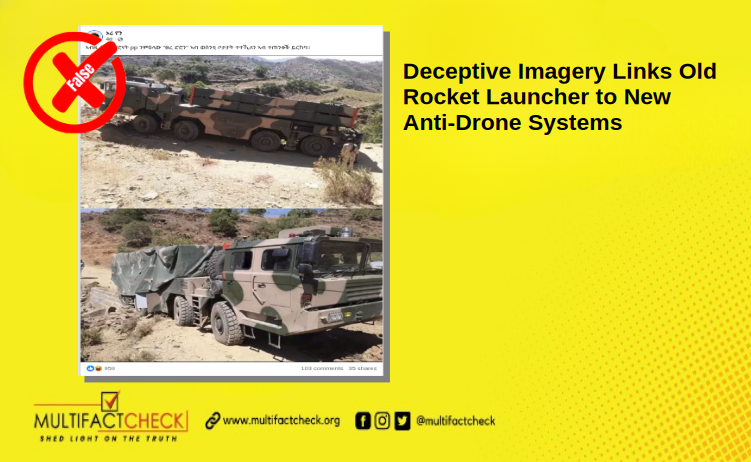
The Claim
On 16 November 2026, a Facebook account with more than 19,000 followers shared a collage of two photos of a military truck. The caption, written in Tigrinya, reads: “ኣብዚ ስዓት ድሮናት pp ንምዕላው ‘ፀረ ድሮን’ ኣብ ወሰንቲ ቦታታት ተተኺለን ኣብ ተጠንቀቕ ይርከባ።”
This translates to: “At the moment, ‘anti-drone’ [systems] to neutralize PP [Prosperity Party] drones have been installed in strategic locations and are on high alert.” The post provides no date, location, or official source for the equipment.
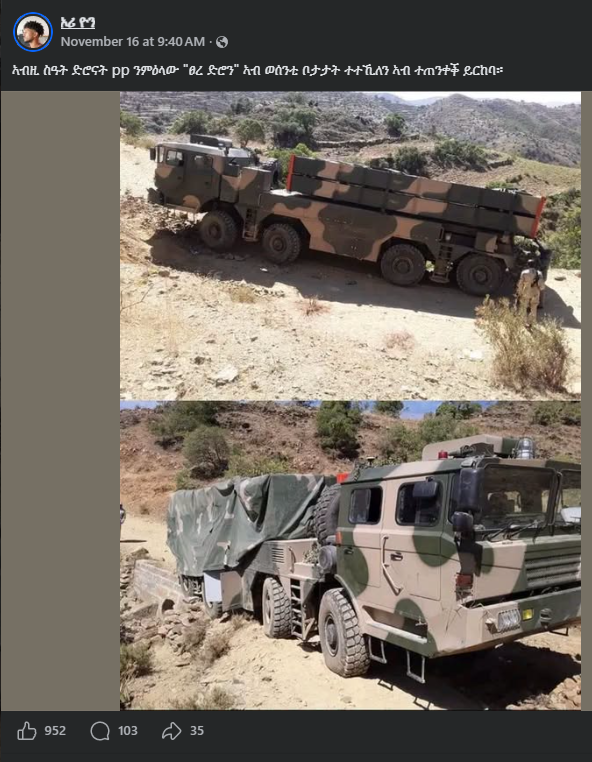
Image 1: Screenshot of the Facebook post, published on 16 November 2026.
Verdict
The photos do not show a newly installed anti-drone system. Reverse-image searches traced the images to a Facebook post from 24 June 2021, more than five years before the post under review. Consequently, they cannot serve as evidence of a system installed in November 2026.
Moreover, the vehicle appears to be a PHL-03-family multiple launch rocket system (MLRS), not an anti-drone system. It fires rockets at distant ground targets; it does not detect or intercept aerial threats. Although the photos cannot confirm the vehicle’s exact variant, operator, or location, the visible launcher and its apparent role contradicts the post’s description.
How the Claim Spread
The post drew substantial engagement. When MFC captured it, the post had 952 reactions, 103 comments, and 35 shares. Yet the caption named no location, date, military unit, or source. It also failed to identify the system it called “anti-drone.” Instead, the images carried the claim: a camouflaged military truck with a large launcher can look convincing, especially to readers worried about drone attacks.
At the time, reports of fighting and drone strikes in northern Ethiopia heightened those concerns. Consequently, the images could seem timely, even though they had circulated years earlier.
The photos show a heavy 8×8 truck carrying a long launcher with rows of large tubes. This configuration appears consistent with a multiple launch rocket system (MLRS), a form of rocket artillery. The vehicle also appears to be Chinese-built and mounted on a heavy military transport chassis. The investigation examines its identification below.
Investigation & Findings
To assess the authenticity of the images, MFC has conducted a thorough investigation using reverse-image searches. Undertaking this investigation, our fact-checking team set out to answer three core questions. Are the photos new? Do they show an anti-drone system? And what do competing versions of this image reveal about its reliability? We conducted a careful reverse image search and examined the military equipment itself.
1. Are the photos new?
We ran both photos through Google Lens and found that they were already circulating widely across different platforms long before this recent post. The results included a Facebook post from 2022, a personal blog from January 2023 covering the Tigray war, and a website article from September 2021 discussing Tigray’s missile war. Additionally, various Facebook pages reposted the photos in February 2023 and again in February 2026, demonstrating that the images resurface periodically.
Although we could not definitively locate the original source or the exact date the pictures were taken, we traced the oldest known appearance. A Facebook page named AFMEER TV posted the image on 24 June 2021. The post featured a Somali-language caption referring to the war in northern Ethiopia, specifically Tigray, and the heavy weapons of the Ethiopian military. Because the photos have been public since June 2021, they cannot be evidence of something installed “at the moment” in November 2026.
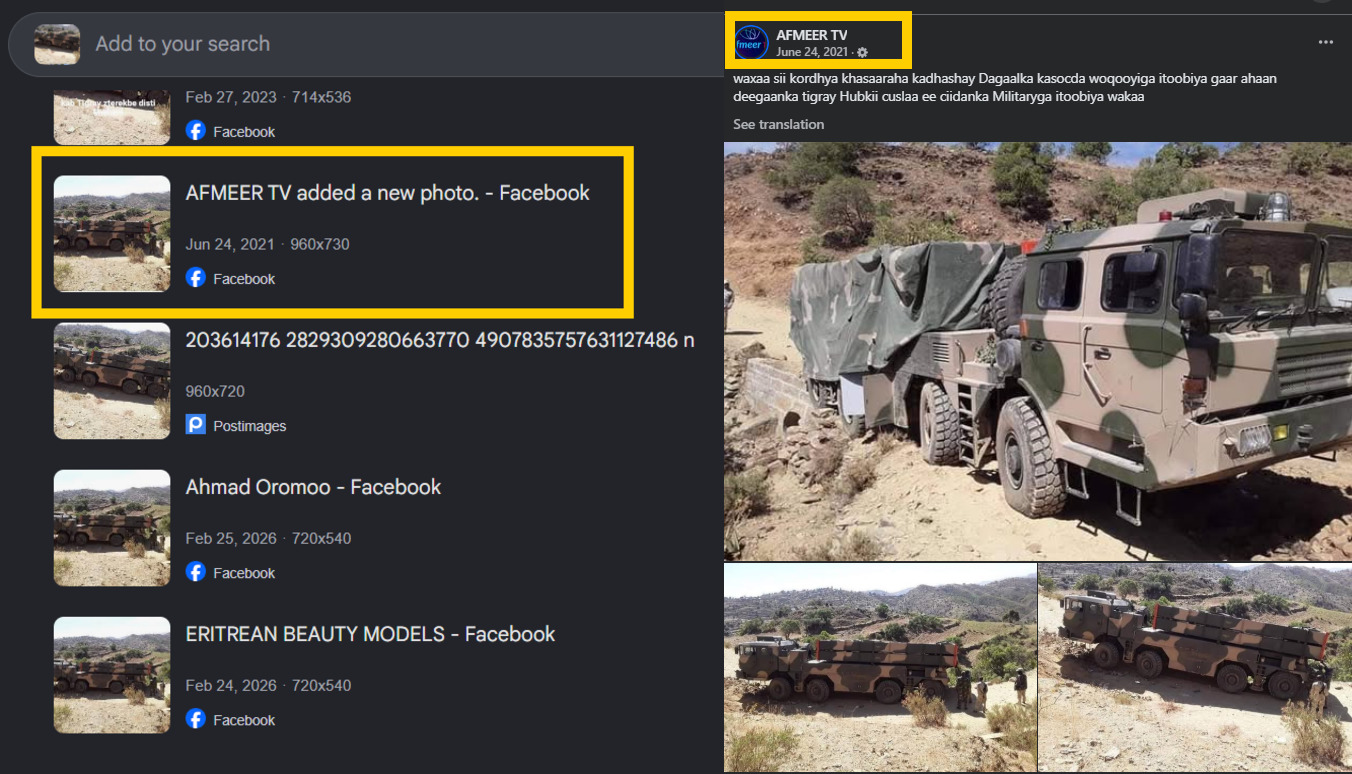
Image 2: Google reverse image search results (left) and the oldest post found, from 24 June 2021 (right).
2. Do the photos show an “anti-drone” system?
The caption asserts that the equipment is an anti-drone system, but the vehicle in both photos is not. The images show a PHL-03 multiple launch rocket system, which is a 300 mm, 12-tube heavy long-range rocket launcher mounted on an 8x8 military truck chassis. The count of the launch tubes on the rear, the number and size of the tubes, and the truck type all match this system. This vehicle is a Chinese development of the Soviet-era BM-30 Smerch design, as described here.
Therefore, the key point lies in what this weapon is designed to do. A launcher like this fires large rockets at distant ground targets, such as bases, depots, and troop concentrations. It cannot detect, track, or shoot down drones. An air-defense or anti-drone system operates very differently, relying on radars, sensors, and interceptor missiles, guns, or electronic jammers. Labeling a rocket artillery truck “anti-drone” is a clear misidentification of the equipment.
The Oryx defense-analysis blog explains the background of this family of launchers. According to its 2021 analysis, the PHL-03 has an export version called the AR2, featuring the same configuration of twelve tubes for 300 mm rockets on a Wanshan WS2400 8x8 heavy truck. Oryx reports that Ethiopia acquired a number of AR2 launchers from China in the late 2010s. Ethiopia and Morocco were the only known customers at that time, and Tigray forces captured the systems when the war began in November 2020. Oryx also catalogues the heavy weapons seen with Tigray forces in a separate list.
MFC cannot definitively say from two photographs whether this particular vehicle is a Chinese-army PHL-03 or an AR2, nor can we confirm who operated it. The photos alone do not settle that question. However, we can state with full confidence what the vehicle is not: it is not an anti-drone system.
3. What does the competing “Eritrea” version tell us?
A different Facebook account shared the exact same collage of two photos a day earlier, on 15 November at 11:43 PM. The page, named Sahel Press Eri, used the images with a completely different context. This version claims the equipment is in Eritrea. Its caption states, in MFC’s translation, that “.....the drone army itself cannot move towards the Eritrean border because the anti-drone defense is installed in a more favorable and secure location…..”
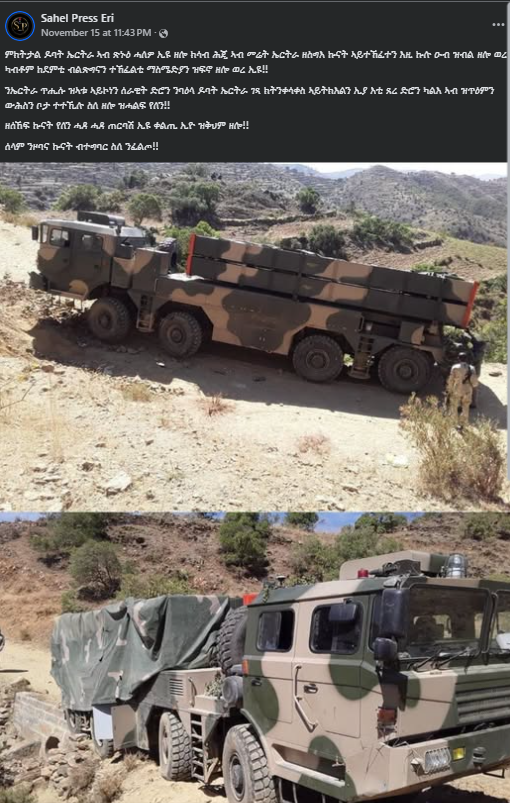
Image 3: Screenshot of the earlier Facebook post using the same photos, from 15 November 2026.
Consequently, within 24 hours, the identical pair of photos was used to support two contradictory stories about where “anti-drone” systems stand. Neither version offers a date, a location, a unit, or an official source. Furthermore, the Eritrea framing lacks support from anything MFC found. Oryx’s 2021 survey names Ethiopia and Morocco as the only known AR2 customers, and we found no public record of Eritrea operating this system. The Eritrea claim rests entirely on its caption.
This pattern is a familiar one in the current information environment. Recycled images get repackaged to fit whichever narrative the sharer wants to push. A genuine photo of a newly installed system would not simultaneously serve as evidence for two opposing accounts, and it would not have been online since 2021.
Context
War dynamics have shifted significantly in recent years. Actors in conflicts increasingly treat drones as a major weapon for gaining the upper hand over their opponents. The war in Sudan and the 2020 to 2022 war in northern Ethiopia stand as clear examples. Drones again play a vital role in the renewed tension between the Ethiopian government and its allies on one side, and the TPLF and its allies on the other.
That context explains why this post found an audience. In early October 2026, Al Jazeera reported that the most severe clashes since the 2020 to 2022 civil war were underway in Tigray, Amhara, and Afar. Eritrea had cut diplomatic ties with Ethiopia, and a blast at the Defence Ministry in Addis Ababa was reported. AFP’s diplomatic source indicated that small drones most probably caused the blast. Al Jazeera added that Ethiopia’s army has a much larger drone arsenal, while rebel forces have used drones against airbases and airports, according to the conflict monitor ACLED.
In a climate of real drone strikes, people are eager for evidence of defenses, and unverified images spread easily. That is exactly why this kind of claim needs to be checked before it is shared. A photo of a rocket launcher presented as an air defense is not merely a labeling error. It can create a false sense of security for people who live under the threat of strikes, and it can feed rumors about what each side is able to do.
Conclusion
The Facebook account presented the photos as current evidence that “anti-drone” systems had been installed at strategic locations. Our investigation proved this to be false. MFC's findings confirm that the photos have been on the internet since at least 24 June 2021, more than five years ago. Furthermore, the vehicle they show is a multiple launch rocket system of the PHL-03 family, which functions as a ground-attack weapon rather than an anti-drone system. Therefore, the claim is rated False.
The broader significance of this finding extends beyond a simple mislabeling. A second post used the same photos a day earlier to make a completely different claim about Eritrea. This demonstrates how recycled imagery gets manipulated to fit evolving narratives. By understanding the true nature of these images, readers can avoid falling for manufactured military claims that serve to inflate a false sense of security or provoke unnecessary panic.