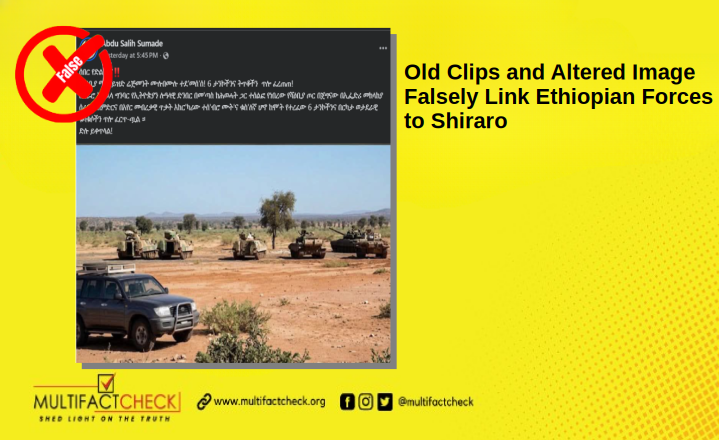
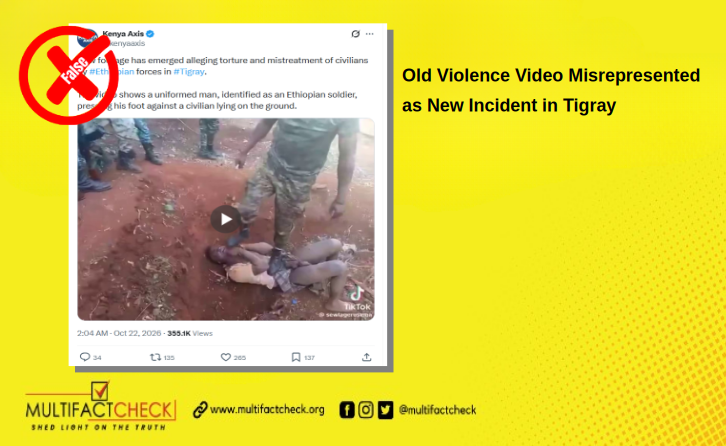
The Claim
On 22 October 2026, an X account with over 118,000 followers shared a graphic video alongside a striking caption. The post claimed: “New footage has emerged alleging torture and mistreatment of civilians by Ethiopian forces in Tigray.” Furthermore, it asserted that the video shows “a uniformed man, identified as an Ethiopian soldier, pressing his foot against a civilian lying on the ground.”
Verdict
The footage is not recent, and no element within it ties the scene to Tigray. It was already spreading on X by 24 February 2024. Nothing in the clip supports its presentation as fresh footage from that region.
Our fact-checking team examined the online history of this video. Reverse image searches reveal that the same clip appeared in posts from February 2024. That is more than two and a half years before the October 2026 claim. Additionally, the footage has only one documented location: Oromia, not Tigray.
How the Claim Spread
By 13 November 2026, when MFC captured the screenshot below, the post had surpassed 355,000 views, 135 reposts, 265 likes, and 34 replies. Its caption names no date, village, unit, or source. Instead, the word “new” and the hashtag #Tigray constitute the entire claim. Graphic footage framed as fresh evidence of abuse in a region scarred by devastating war is precisely the kind of content that spreads rapidly and escapes scrutiny.
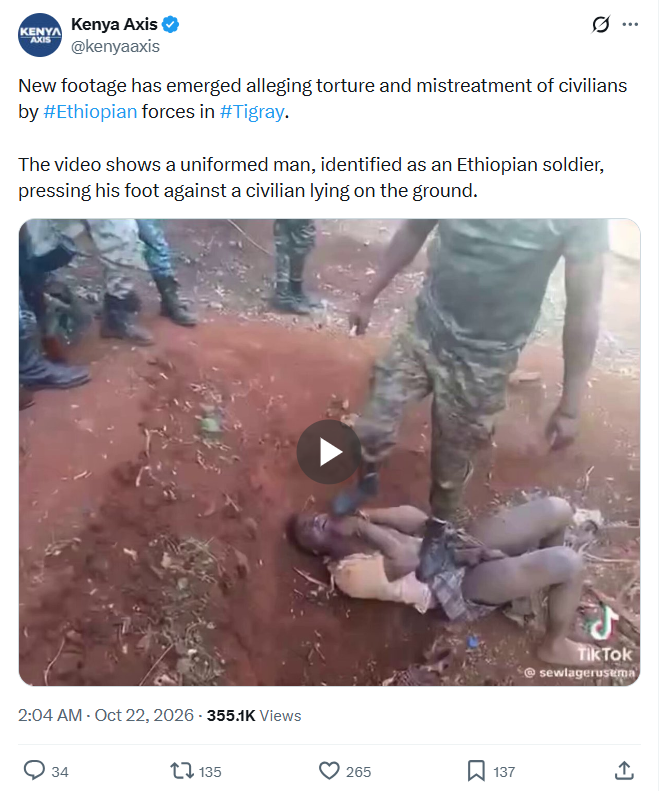
Image 1: Screenshot of the X post, taken on 13 November 2026 at 8:30 PM.
Investigation & Findings
The MFC fact-checking team structured its investigation around four sequential questions, each building methodically upon the last. First, the team examined whether the video was recent. Second, it sought to identify the victim. Third, it analyzed who the perpetrators were. Finally, it worked to establish where the incident occurred.
To answer each question, our team relied on a layered methodology. The team extracted and reverse-searched keyframes, then cross-referenced visual matches across platforms. It also analyzed audio in multiple languages, compared parallel recordings of the same scene, and traced the clip’s digital footprint to its earliest available instance. Where verification reached its limit, the team states those boundaries plainly rather than speculating beyond the evidence.
1. Is the Video Recent, as the Post Claims?
Our team extracted keyframes from the video and ran them through Google Lens for reverse image searches. The results returned several similar images, including X posts that already carried the same clip and the very post under review.
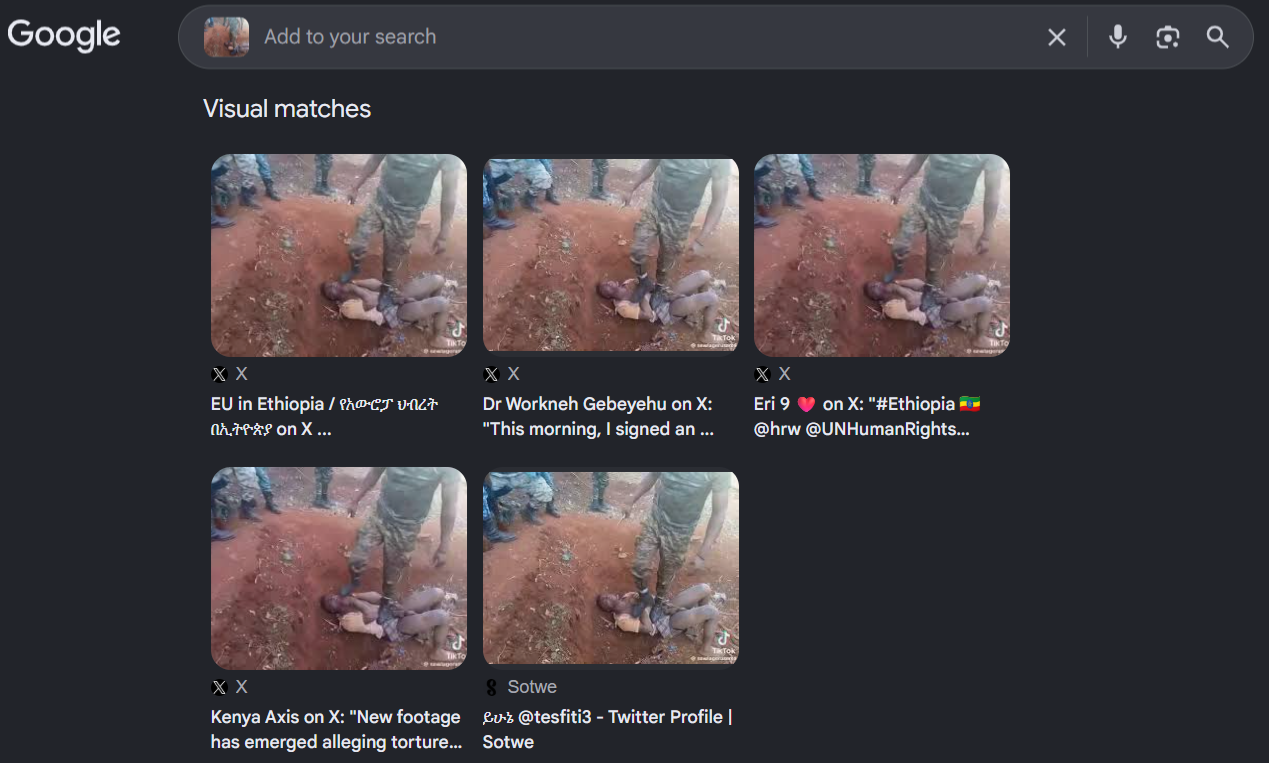
Image 2: Screenshot of the Google Lens reverse image search results.
Digging further into the results, and after a second round of searches, we found two much older posts that publicly carried the same footage:
➤ A post from 25 February 2024 by the account @ShiferawAnteneh. It blames the “Oromo Liberation Front OLF” and calls it an “Abiy sponsored army,” without naming a place or a victim.
➤ Another post from 16 October 2024 by the account @ETHDefenders. It uses the hashtag #AmharaGenocide. It is unclear whether the account means the incident took place in the Amhara region or that the victim was ethnically Amhara.
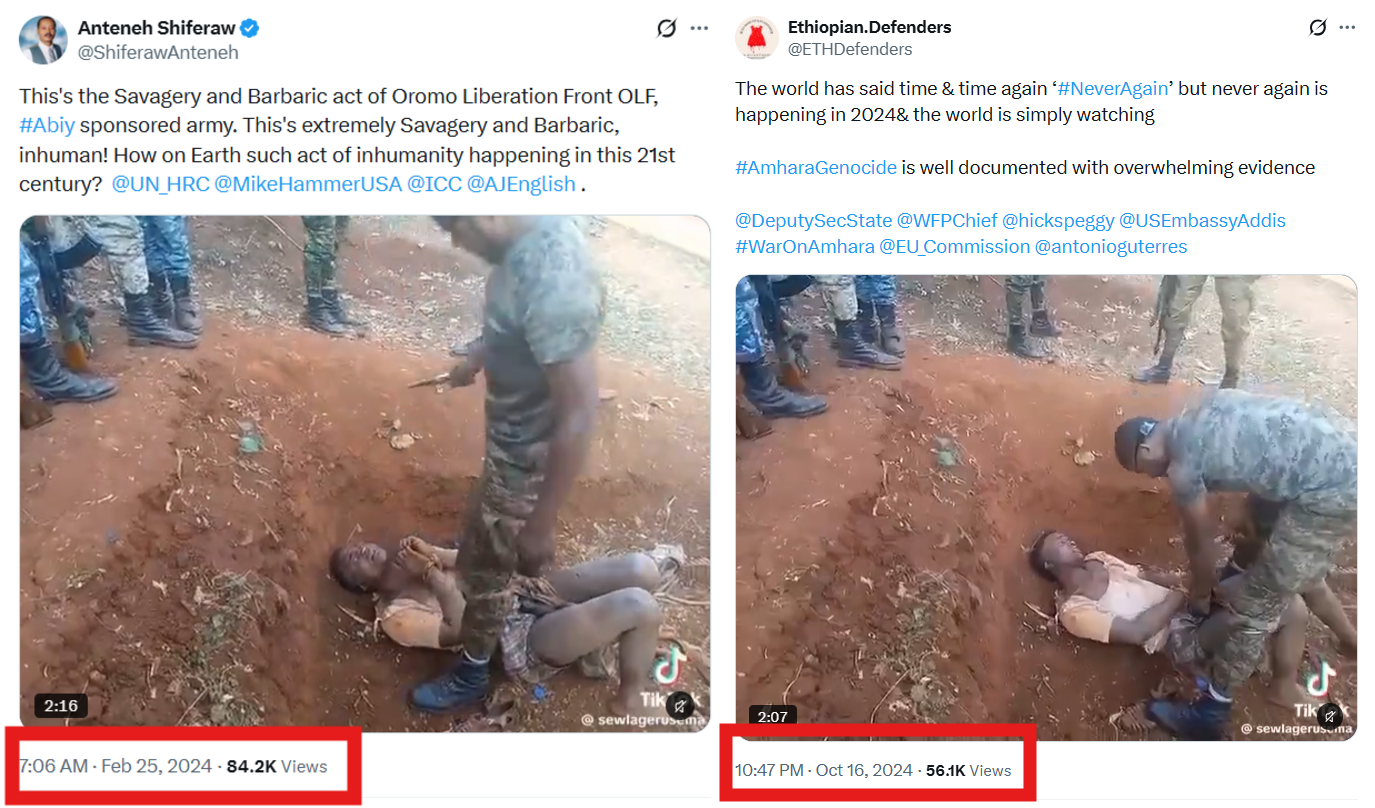
Image 3: Screenshots of the two X posts, from different accounts and different dates (25 February 2024 and 16 October 2024).
These posts are not evidence of what happened, and MFC does not treat them as such. Their value is narrower and firmer: they prove that the footage was already public long before the October 2026 post. The team then traced the clip even earlier. Copies were posted on X on 24 February 2024, such as this one, which is the earliest instance we could locate.
A clear pattern emerges here. Within months, this clip was used to blame an Oromo armed group and then to allege genocide against Amhara. Now in 2026, it is being sold as evidence of abuse in Tigray. A genuine, newly emerged video would not have three incompatible identities and a two-and-a-half-year paper trail. The footage is not recent. It has been online since at least 24 February 2024.
2. Who Is the Victim?
To answer this, our team continued searching with different screenshots and found a statement from the Oromo Liberation Army (OLA) account on X (@OLF_OLA) dated 26 February 2024. This statement identified the victim as an Oromo man named Ahemad Qaasim Duubee and stated that he was tortured to death by Ethiopian uniformed security forces in East Guji Zone. It also included a second video of the incident, filmed from a different angle.
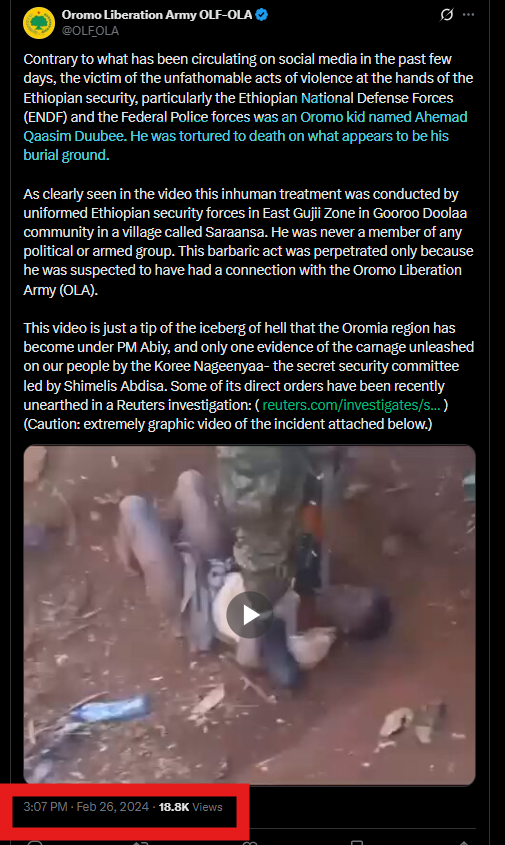
Image 4: Screenshot of the OLA statement on X, posted on 26 February 2024.
Because the OLA is a party to the armed conflict in Oromia, MFC treats its statement as an allegation, not as established fact. However, the second video lets us test whether both recordings show the same event. They do. The camera angle differs, which could mean the person filming moved or that a second person—perhaps one of the soldiers standing around the victim—was recording. Yet the scene is the same: the same main perpetrator is in the same spot, with the same surrounding soldiers, and the same victim.
The footage also differs in time and detail. In the clip circulated by Kenya Axis, the main perpetrator threatens and tortures the victim with a bayonet. In the clip attached to the OLA statement, the same man uses a soldier’s gun on the same victim. This means one video was recorded minutes before the other. Two recordings of one scene, made from two positions at slightly different moments, strongly indicate a single incident rather than a staged or composite clip.
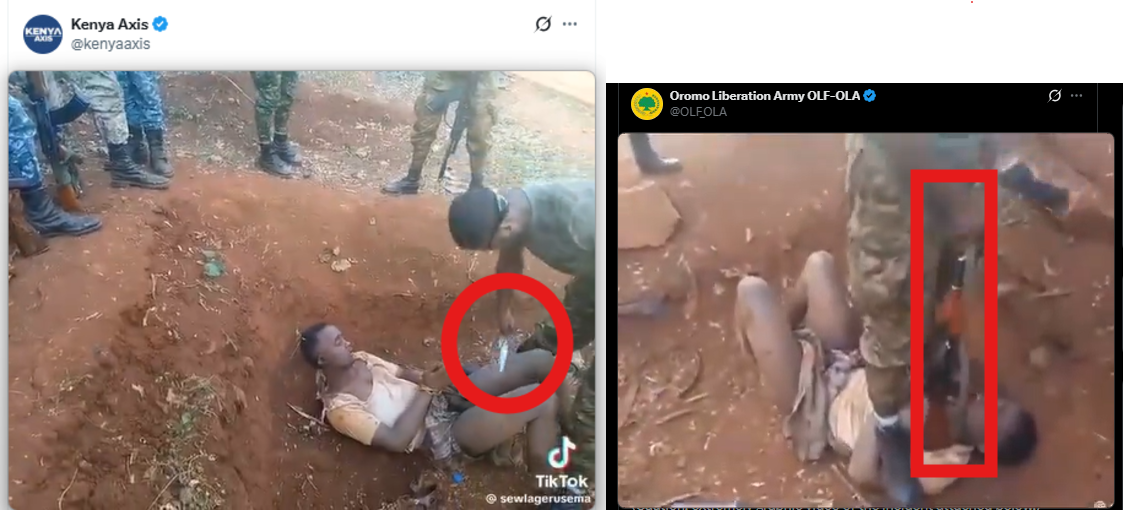
Image 5: Screenshots of both camera angles, showing the different tools the perpetrator used on the victim.
The audio provides further evidence of what the victim endured. At 24 seconds into the video, one of the soldiers says in Amharic: “አንተ አይሞትም እንዴ? ሌሊቱን ሙሉ ቀጥቅጬዋለሁ” (“Doesn’t he die? I beat him the whole night”). At 10 seconds into another copy, the main perpetrator says in Amharic: “ጆሮህን እንዳጣህ አንገትህን ታጣለህ” (“Just as you lost your ear, you will lose your neck”). The victim is also beaten with a stick, and the main perpetrator steps on him several times. At 1 minute and 14 seconds, one of the soldiers tells the victim in Afaan Oromo: “Muluu yoo haasoofte malee morma kee sirra kuta” (“If you don’t tell the whole thing, he will cut your neck”). This offers a clue, not proof, that the victim may speak Afaan Oromo.
MFC could not independently verify the victim’s name as reported by the OLA. No human rights organization has published a report on his treatment or what happened to him afterward. We cannot confirm whether he is alive or dead after the torture. We state this limitation plainly because it matters: the unanswered questions concern the victim’s identity and fate, and none of them affects the core question of this fact-check—whether this is new footage from Tigray.
3. Who Are the Perpetrators?
The team viewed the video frame by frame to identify faces, insignia, and background details. The low quality of the video limits what can be established, but two things are clear:
➤ Uniforms: At least three different security forces appear. These include the Ethiopian National Defence Force, the Federal Police, and the Special Forces Police uniform from one of Ethiopia’s regional governments. Because the badge or symbol on the third force is illegible, we cannot identify which region it belongs to.
➤ Language: The soldiers surrounding the victim speak Amharic and Afaan Oromo.
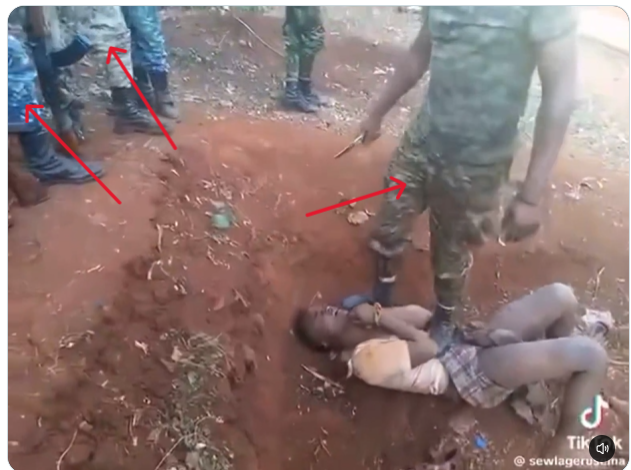
Image 6: The red arrows mark troops wearing three different uniforms in the footage.
This is consistent with the allegation that state security personnel carried out the abuse, and the OLA statement says the same. However, MFC could not identify any individual or unit, and we do not know whether anyone has been investigated. Crucially, nothing in the uniforms or languages points to Tigray.
4. Where Did It Happen?
Geolocation was not possible from the images. Most of the footage is filmed looking down toward the victim, who lies in a pit in the ground, so there are no landmarks, buildings, or skylines to match against maps or satellite imagery.
A TikTok watermark is visible on the video, which shows it was first shared on that platform. MFC could not locate the original TikTok upload, and given how graphic it is, the platform may have removed it. The only indication of location comes from the OLA statement mentioned above. It places the incident in the Oromia region, in East Guji Zone (Oromia has recently changed its zonal structure), in a community called Gooroo Doolaa, in a village called Saraansa. We could not verify this independently, but it is the only specific location on record for this footage, and it is not in Tigray.
Context
For the past decade, Ethiopia has seen a series of conflicts that continue in different parts of the country, and they have repeatedly been accompanied by atrocities against civilians. Soldiers and other conflict actors have filmed themselves torturing or killing their opponents, “enemies,” and civilians alike, and these videos often reach social media with no date, no location, and no verified context.
Human rights organizations have documented abuses by many sides. In 2024, Human Rights Watch described the country’s human rights situation as “dire,” citing UN findings of extrajudicial executions, sexual violence, and torture by military forces. A joint HRW and Physicians for Human Rights submission to the UN described a pattern of extrajudicial killings, torture, and arbitrary arrests in Oromia by security forces and by armed groups including the OLA. The Ethiopian Human Rights Commission (EHRC) has also reported extrajudicial killings and forced disappearances in Amhara and Oromia, and in February 2024 Amnesty International called for an end to extrajudicial executions in the Amhara region. The US State Department’s 2024 country report draws on these sources and records numerous cases of extrajudicial killings in Amhara, Oromia, and other parts of the country, including Tigray.
The OLA statement also points to a Reuters investigation published in February 2024, which reported that a secretive body in Oromia called the Koree Nageenyaa (“Security Committee” in Afaan Oromo) ordered dozens of killings and hundreds of arrests. Addis Standard summarized the findings, including that the EHRC confirmed the committee’s existence. The investigation appeared in the same week the video surfaced and does not mention it, and MFC cites it only as the background the OLA statement invokes, not as proof about this video.
Soldiers from the Ethiopian National Defense Force, Eritrean Defense Forces, Tigray People’s Liberation Front forces, Amhara Fano forces, and the Oromo Liberation Army, among other actors, have been accused by human rights organizations of committing abuses at different times over at least the past eight years. The post examined here was shared in this charged context, which is precisely why accuracy about the date, place, and perpetrators matters.
Conclusion
The X account presented the footage as new evidence that Ethiopian forces were torturing civilians in Tigray. MFC’s investigation shows that neither claim is accurate. This video, which has nothing to do with Tigray, has been accessible online since at least 24 February 2024. The only location mentioned in connection with the footage is in Oromia, and neither the uniforms worn nor the languages spoken link it to Tigray.
Although the video appears to show genuine acts of brutal violence against a defenseless man, the deception lies in its label: an old video recycled as “new” and attached to the wrong region. Therefore, the claim is rated False.