The Claim
Since November 3, 2026, a video clip and a still image taken from it have circulated on X and Facebook. Posts present them as proof that Ethiopian federal forces have entered Shiraro, a town in northwestern Tigray.
Verdict
The video is more than five years old. MFC traced it to a Facebook post dated May 29, 2021, and found no link to the current fighting in northern Ethiopia. The still image shared with it was made or edited with Google AI. Neither shows events in Shiraro in November 2026.
MFC reached this verdict after examining the two pieces of visual material separately. First, reverse image search traced the video to a Facebook reel published on May 29, 2021 by the page Eritrea Watch. That date is more than five years before the claims. Second, MFC ran the still image through Google DeepMind’s SynthID Detector, which returned “SynthID was detected” and “This media was made or edited with Google AI,” with high confidence. The still also differs sharply from the low-resolution source footage in clarity, detail and quality. Together, these findings show that neither item can depict events in Shiraro in November 2026.
How the claim spread
The video shows a column of armored vehicles, uniformed personnel, and a Toyota Land Cruiser. Several X accounts shared it, including @afric_insde (Inside Africa), @TheAbyssinianHQ and @Soudri. Captions included: “Ethiopian federal forces entered Shiraro, a strategic town in northwestern Tigray, on Tuesday after weeks of fighting and military advances.” Another read: “The Ethiopian army has also established control in the western region of the Tigray insurgency. The army has been deployed to the region.” The Inside Africa post was published on November 3, 2026, and had about 12,900 views when MFC captured it (Image 1). It added that the development drew renewed attention to the disputed border town of Badme, while noting that no offensive against Badme had been confirmed.
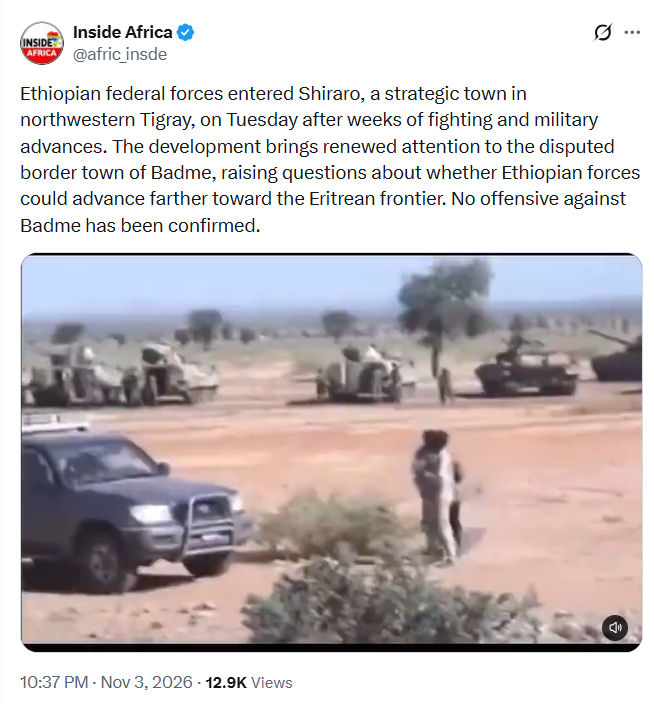
Image 1: Screenshot of the Inside Africa post on X, published on November 3, 2026, presenting the video as showing Ethiopian forces entering Shiraro.
A still image taken from the same footage circulated separately on Facebook in a photo post, a second post and a third post . The posts were framed as breaking news, with near-identical English and Amharic captions. They claimed the Eritrean mechanized force on the Shiraro front had come under heavy attack: “The Eritrean mechanized force got attacked highly In Shiraro front” (በሽራሮ–አዲኳላ ግንባር የተሰማራው የኤርትራ ሜካናይዝድ ኃይል ከፍተኛ ጥቃት እንደተፈጸመበት ተገለጸ). One post went further (Image 2). It claimed an Eritrean mechanized regiment had been wiped out and had fled, leaving six tanks and other weapons behind.
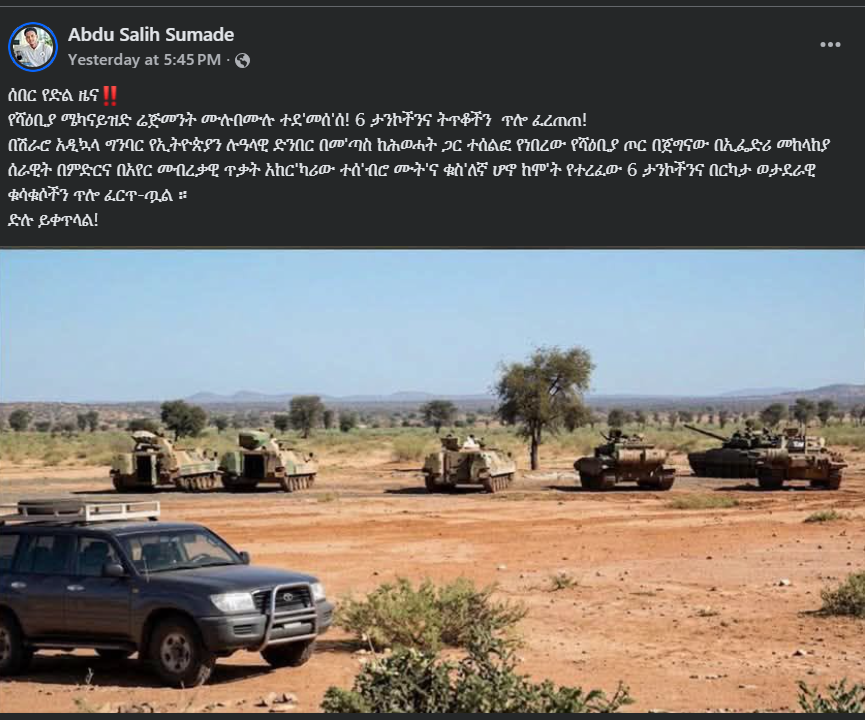
Image 2: Screenshot from Facebook of a post with an Amharic caption claiming an Eritrean mechanized regiment was destroyed on the Shiraro front.
Investigation & Findings
The posts relied on two separate pieces of visual material, so MFC examined each on its own. First, is the video recent? Second, is the still image an authentic frame from that video?
Is the video recent?
MFC used the InVID-WeVerify extension for Google Chrome to split the clip into key-frames. It then ran each key-frame through Google reverse image search. The search led to an earlier copy of the footage, shared as a Facebook reel on May 29, 2021 by the page Eritrea Watch. The page described it as a video of Ethiopian and Eritrean mechanized forces coordinating around Badme (Image 3). The footage is therefore more than five years older than the claims made about it.
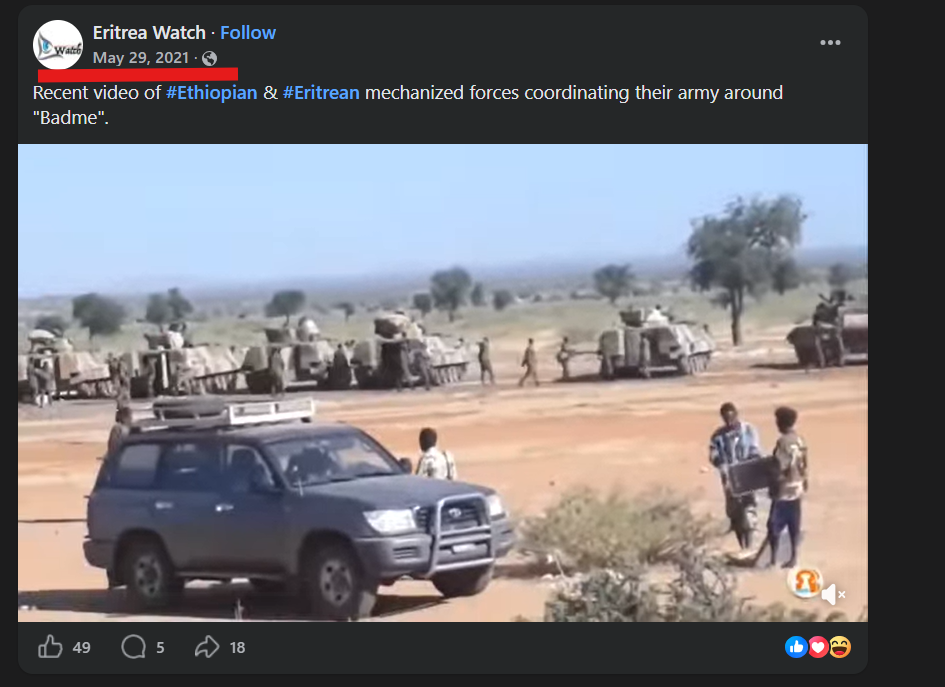
Image 3: Screenshot from Facebook of the reel posted by the page Eritrea Watch on May 29, 2021. The date is marked in red.
Three points follow from this finding. The scene is the same: frames from the 2026 X post (Image 1) and the 2021 reel (Image 3) show a dark Toyota Land Cruiser in the foreground, a line of armored vehicles behind it, and a lone tree in the middle distance. The 2021 date is a floor, not a filming date, because it is the earliest copy MFC could find and the footage may be older still. The 2021 caption is itself unverified, since MFC did not independently establish where the footage was filmed or which forces appear in it. The references to Badme and to Ethiopian and Eritrean units are the up-loader’s description. What the date establishes is narrower, and sufficient: footage published in 2021 cannot show an event from November 2026.
Still, the 2021 caption shows how far the footage has drifted from its original framing. If accurate, it described Ethiopian and Eritrean units acting together. That fits the alliance of the 2020–2022 Tigray war, when Eritrean forces fought alongside the federal army. By early October 2026, the two governments had severed diplomatic relations. Addis Ababa was accusing Asmara of backing Tigrayan rebels, an accusation Eritrea denies, according to Reuters. Footage of one alliance was recycled as evidence of its opposite.
Is the still an authentic frame?
The still circulating on Facebook (Image 2) shows the same scene but looks very different from the source video, which is low-resolution and blurry (Image 3). That gap in clarity suggested the still had been enhanced or regenerated with AI. MFC compared the two images. The 2021 video frame (Image 3) is low-resolution, with soft terrain and a hazy horizon, and uniformed personnel walk near the vehicles. The 2026 still (Image 2) is much sharper, with saturated colors, a clear sky, detailed gravel and rocks in the foreground, crisp distant hills and finely rendered shrubs. No people are clearly visible.
These differences are consistent with AI processing. AI tools reconstruct detail rather than recover it, so they can invent texture, such as the gravel and distant hills, and drop or reshape parts of the original scene. Some differences could also reflect a different moment in the clip. MFC therefore treated the comparison as a lead, not as proof.

Image 4: Screenshot from Google’s SynthID Detector (analysis view) showing where the watermark was detected (blue) and where the result was uncertain
To test it, MFC ran the still through SynthID Detector, a verification portal from Google DeepMind. The detector returned “SynthID was detected” and “This media was made or edited with Google AI.” The analysis view rated its confidence as high (Images 4 and 5). In that view, blue marks areas where the watermark was detected and orange marks areas where the result was uncertain. The result confirms that the circulated video still passed through a Google AI tool and is not an unaltered video frame. It cannot establish who processed the image, when or why, or whether it was up-scaled, enhanced or generated from scratch. The detector also notes the media may have been edited further after it was watermarked. Given how closely the scene matches the 2021 footage, MFC considers it most likely that the image was derived from that footage and enhanced with AI.
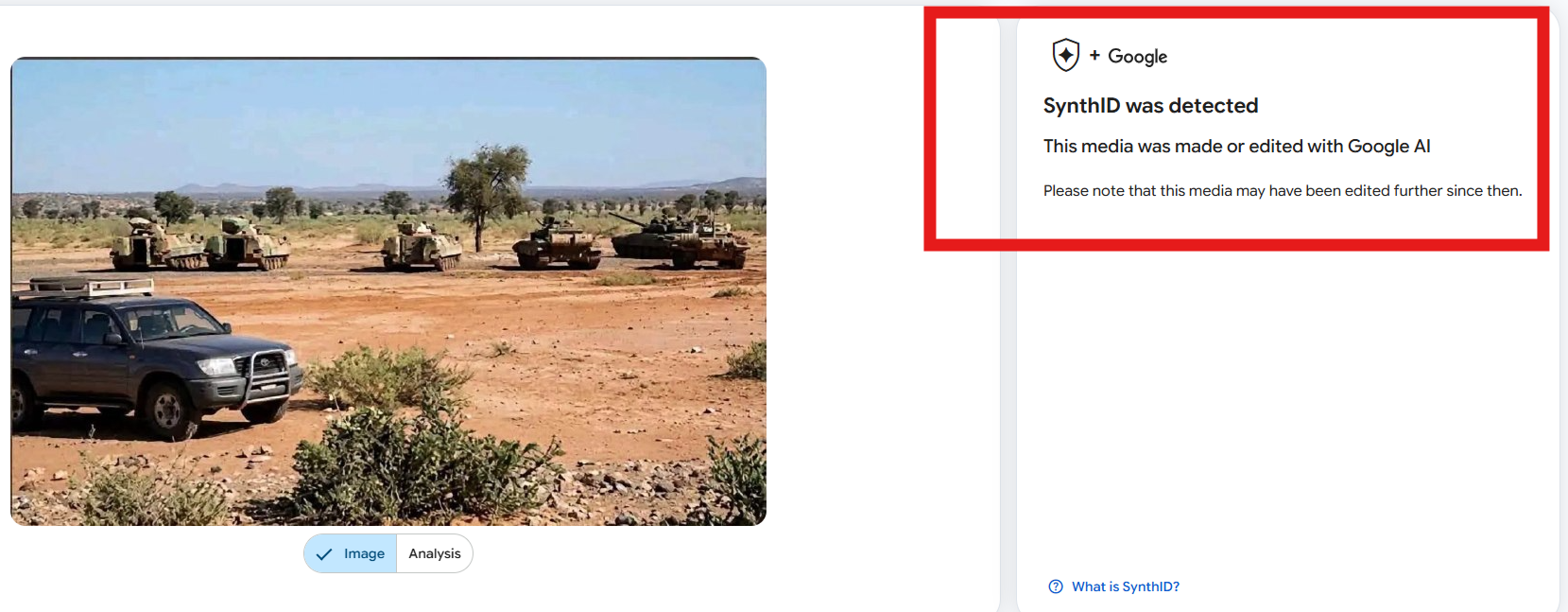
Image 5: Screenshot from Google’s SynthID Detector showing the circulated still and the detection result, which is highlighted in red by MFC.
Context
The claims circulated during the most serious escalation in northern Ethiopia since the 2020–2022 Tigray war. An African Union envoy estimated that war killed about 600,000 people. The African Union-brokered Pretoria agreement of November 2022 ended the war. By February 2026, however, the BBC reported that the accord was “unraveling fast.” Disputes centered on western Tigray, the legal status of the Tigray People’s Liberation Front (TPLF), a split inside the TPLF, and Addis Ababa’s insistence on access to the Red Sea.
Fighting resumed on September 23, 2026, when Tigrayan forces seized three airports and clashed with federal troops in several locations. The federal government and the TPLF-led authorities each accused the other of starting the offensive. In early October, federal and allied forces retook the regional capital, Mekelle, after the TPLF said it had withdrawn. On October 13, they reached Zalambessa on the Eritrean border.
Shiraro lies in Tigray’s North Western Zone, close to the Eritrean border and the disputed Badme area. Badme was the flash point of the 1998–2000 Ethiopia–Eritrea border war. An independent boundary commission later ruled that it belongs to Eritrea. The town has featured repeatedly in the 2026 fighting. On October 9, France 24 reported that Tigrayan forces were retreating toward it, citing an official from a dissident TPLF faction. ACLED, a conflict-monitoring group, later recorded that Eritrean forces and the Tigray Defense Forces (TDF) left Shiraro on October 12. No one controlled the town afterwards, while federal forces held the surrounding area. On November 3, 2026, the same day the Inside Africa post appeared, ACLED logged that the Ethiopian National Defense Force (ENDF) had entered the town.
Conclusion
MFC traced the video shared on X and Facebook as evidence that Ethiopian forces entered Shiraro to a Facebook post from May 29, 2021. That is more than five years before the claims. The still shared alongside it carries Google’s SynthID watermark and was made or edited with Google AI. It also differs from the source footage in clarity, detail and quality. Neither item is evidence of events in Shiraro in November 2026. Neither shows an attack on, or the destruction of, an Eritrean mechanized unit. MFC therefore rates the claim that this footage and image show a recent ENDF advance into Shiraro as False.
This rating applies to the visual material. It does not settle what is happening on the ground. ACLED reports that the ENDF entered Shiraro on November 3, 2026. Claims of heavy Eritrean losses in the area are disputed and unverified. MFC has not independently confirmed or ruled out either. The episode shows how a real military development can attract false evidence, and how recycled or AI-enhanced images lend false certainty to events that remain unclear.