By Kirubel Tesfaye
Claim
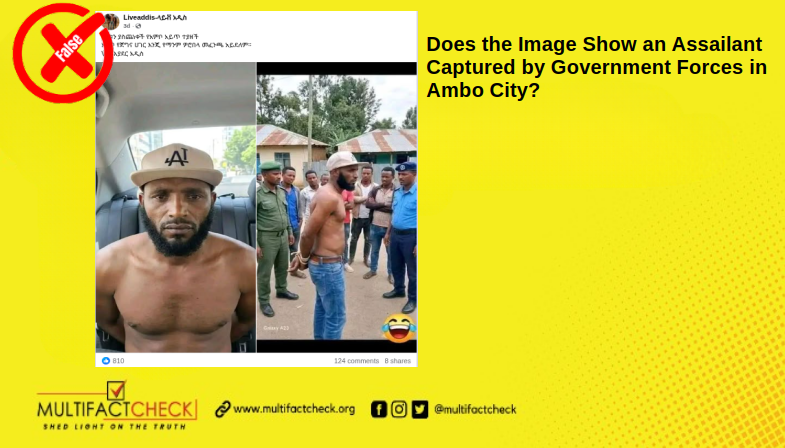
A Facebook page with over 160,000 followers shared images claiming to show an assailant captured by government forces in Ambo city of the Oromia Region, generating hundreds of likes and comments. These images, which depict a bound man surrounded by individuals in law enforcement uniforms, have since circulated widely across Facebook and X, reaching thousands of additional users.
Verdict
False. MFC’s investigation into the authenticity of these images proved that they were generated by artificial intelligence. Despite these images being shared online, MFC concluded that the claim is False and doesn’t show the alleged person, named Kassaye Kenenisa, detained in Ambo city, Oromia.
Investigation and Findings
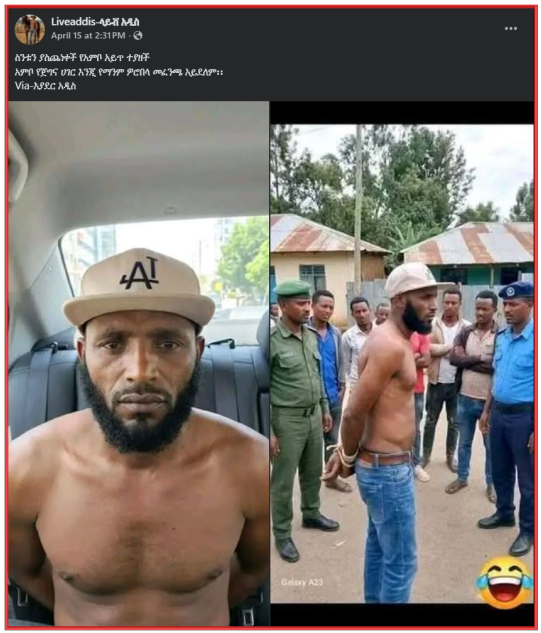
A Facebook page with more than 160,000 followers shared two images claiming to show an assailant in Ambo city who had been captured by government forces. The post was captioned: “The person (rat) who troubled many in Ambo has been captured. Ambo is a place of courage, not a refuge for those who seek to hide.”
By the time this article was published, the post had garnered more than 780 likes and 120 comments, indicating significant engagement and reach within the online community.
The images were also circulated by other social media users on Facebook (see links: here, here, and here) and on X (formerly Twitter) (See here), where they reached thousands of additional engagements.
The images show a man with a beard and a baseball cap, with his hands bound behind his back, standing in an outdoor area surrounded by a group of men, including two individuals in what appear to be law enforcement uniforms.
MFC conducted a rigorous digital investigation using multiple open-source investigation techniques to assess the credibility and authenticity of the two shared images. Our team applied reverse image search techniques to both images. The results showed that neither image had been published anywhere on the internet before the date the Facebook post was shared.
The complete absence of any prior publication strongly suggests the images were freshly created, consistent with AI generation, rather than captured from a real event. Our fact-checking team used Google’s “About This Image” section, which tracks the indexed publication history of an image across the web. The tool confirmed that both images had no traceable history before their appearance in the Facebook post and flagged indicators consistent with AI-generated content, labeled “Made with Google’s AI.”
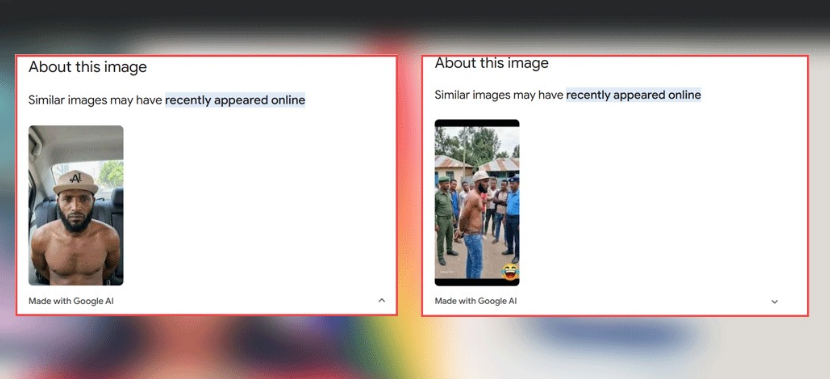
This tool is part of Google’s broader effort to combat synthetic media and provides an additional layer of verification beyond standard reverse image searches. Beyond automated tools, MFC conducted a close visual inspection of both images and identified several anomalies characteristic of AI-generated content, such as visible text fragments resembling “LA” or “Los Angeles.” In the first image, text consistent with Los Angeles urban signage is faintly visible in the background.
A laughing emoji is also visible in the bottom right corner of one of the images. MFC’s analysis determined that this emoji appears to have been digitally overlaid onto the image after its generation, based on differences in resolution and color saturation compared to the surrounding content. This suggests the person who posted the image deliberately added a mocking element, indicating an intent to ridicule rather than to genuinely report an arrest. The background environment also contains visual distortions in depth and perspective that are commonly produced by AI image generation models when rendering crowds and outdoor scenes.
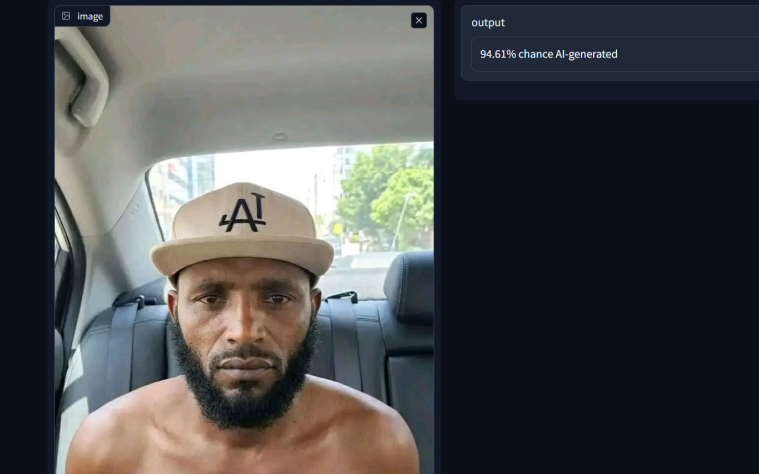
Our team also used the Hugging Face AI Image Detector to determine whether the image depicted a real incident or was computer-generated. The tool returned a 94.61% chance that the image is AI-generated.
Context
In April 2025, an online conversation emerged about a man named Kassaye Kenenisa, who is alleged to own a hotel in Ambo city and to have organized a group referred to locally as “120”. According to online discussions, this group is accused of operating with impunity, committing acts of violence without accountability.
Videos circulating online, which MFC has reviewed, appear to show a man beating individuals inside a building. In these videos, the victims can be heard pleading in Afaan Oromo, crying and screaming, as they are subjected to what appears to be brutal violence. Additional footage allegedly shows the same individual beating a person in the middle of a public crowd.
It is this climate of public anger and demand for accountability that appears to have created fertile ground for the spread of fabricated imagery depicting an arrest that, according to MFC’s investigation, never took place. No official statement from Ambo city authorities or the Oromia regional government confirming the arrest of Kassaye Kenenisa had been issued at the time of publication.
Conclusion
A detail-oriented investigation of the images proved that they do not show the alleged individual named Kassaye Kenenisa, detained in Ambo city, Oromia. Rather, MFC’s investigation shows it is AI-generated user content. Hence, based on its findings, MFC rates this claim as False.