By Naol Kenie
Claim
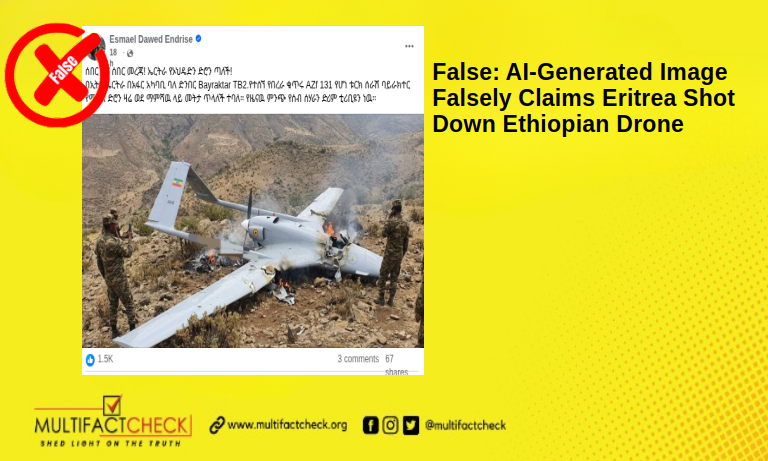
A Facebook user shared an image claiming that Eritrea shot down an Ethiopian drone near the Ethio-Eritrea border.
Verdict
False. The image is AI-generated and does not show Eritrean forces shooting down an Ethiopian drone.
How the Claim Spread
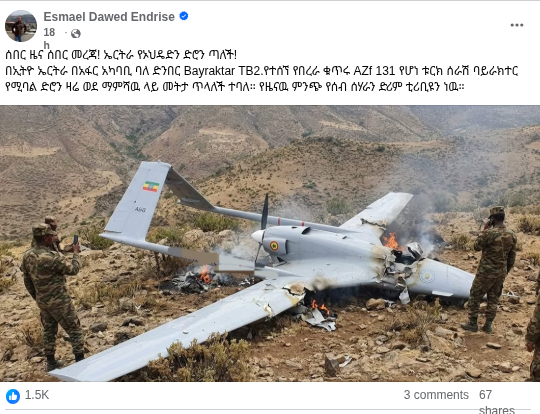
On March 25, 2026, a Facebook user named Esmael Dawed Endrise, who holds a verified blue badge and has more than 68,000 followers, shared an image as “Breaking News.” The user claimed that Eritrea had shot down an Ethiopian drone near the Ethio-Eritrea border. Before this article was published, the post garnered more than 1,500 reactions and 65 shares. Additionally, the same post was reshared on X (formerly Twitter) and Facebook by different users after the initial post went viral.
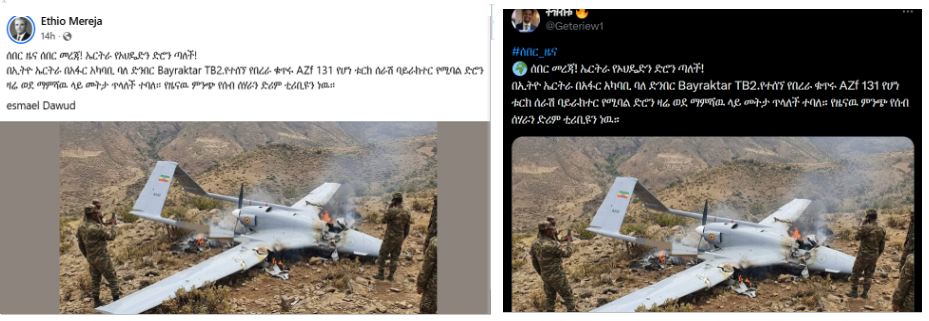
The Amharic caption of the post reads: “Breaking News! Breaking Information! Eritrea Shoots Down an OPDO Drone! A Turkish-made Bayraktar drone, flight number AZf 131, was shot down by Eritrea near the Ethio-Eritrea border in the Afar region this evening.”
The post also claimed that the source of the news was the “Sub-Saharan Dream Tribune.”
Investigation and Findings
MFC reviewed the claim and examined the evidence carefully. The team analyzed the image using multiple online AI-detection tools, including Hugging Face AI Image Detector and others. The results showed a very high probability that the image was AI-generated.
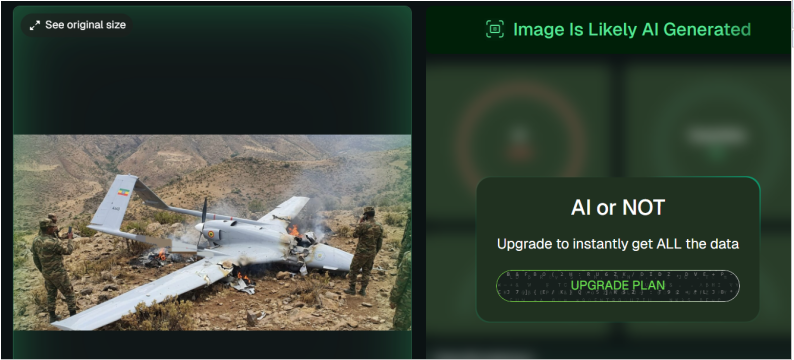
1. AI or Not:
The MFC team utilized the aiornot.com tool. The result indicated that it is “Likely AI generated”.
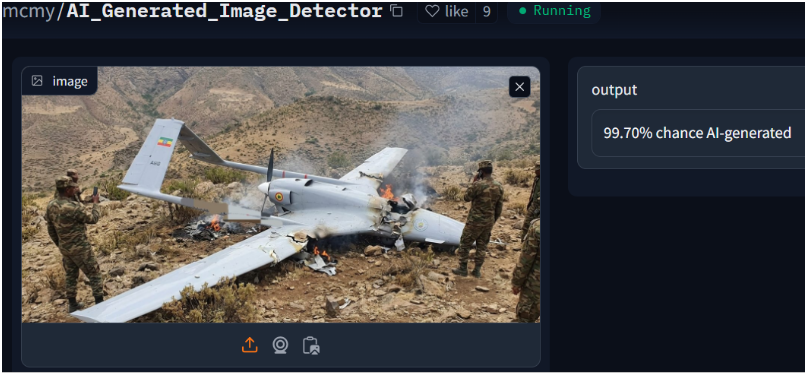
2. Hugging Face AI Image Detector:
Our team also used the Hugging Face AI Image Detector to determine whether the image depicted a real incident or was computer-generated. The tool returned a 99.70% probability that the image is AI-generated.
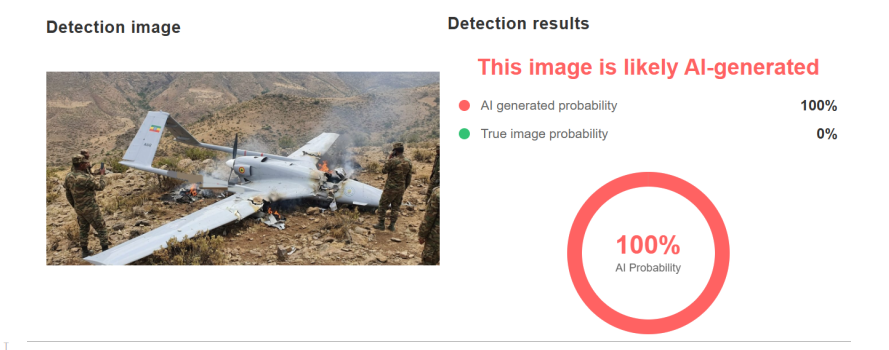
3. Decopy AI:
Additionally, the team uploaded the image to decopy.ai, a tool used to detect synthetic media. The result showed a 100% probability of the image being AI-generated.
Furthermore, MFC attempted to verify the original source mentioned in the post: the “Sub-Saharan Dream Tribune.” Despite extensive efforts to locate this outlet, we could find no news agency by that name in open-source records. This appears to be a tactic designed to deceive social media users by citing a non-existent entity that sounds like a legitimate media organization.
Additionally, the team searched for corroborating reports from established news agencies or official statements from the governments of either state; no such information was found.
Context
Relations between Ethiopia and Eritrea have reached their most precarious point since the 2018 rapprochement, primarily driven by Prime Minister Abiy Ahmed’s vocal demands for sovereign sea access. Ethiopia, the world’s most populous landlocked nation, has framed the pursuit of a Red Sea port as an “existential” necessity, even hinting at the use of force to secure the port of Assab if diplomatic efforts fail. This rhetoric, combined with the January 2024 memorandum of understanding between Ethiopia and the breakaway region of Somaliland, has deeply alarmed Eritrea, which views these moves as direct threats to its territorial integrity and sovereignty. In response, Eritrea has reportedly shifted toward a defensive posture, moving troops toward the shared border and allegedly forming tactical alliances with various Ethiopian dissident groups.
The tension is further complicated by the fallout from the 2022 Pretoria Agreement, which ended the war in Tigray but fractured the “war pact” between Addis Ababa and Asmara. Eritrea, which fought alongside the Ethiopian federal government against the Tigray People’s Liberation Front (TPLF), was not a signatory to the peace deal and remains deeply suspicious of the TPLF’s continued existence and the federal government’s shift in strategy. This distrust has led to accusations from both sides; Ethiopia has recently accused Eritrea of occupying parts of its territory and backing regional rebels, while Eritrea accuses Ethiopia of expansionist ambitions. As of early 2026, international observers and the Global Peace Index have flagged the Ethiopia-Eritrea relationship as one of the world’s highest-risk conflict dyads, with many fearing that even a minor miscalculation at the border could ignite a full-scale regional war.
The claim is circulated in this context.
Conclusion
Based on our investigation and analysis, the image claiming to show an Ethiopian drone shot down by Eritrea near the shared border is AI-generated. Therefore, MFC rates this claim as False.
MFC advises the public to remain vigilant regarding images circulated on social media and to verify information through credible sources before believing or sharing it.