
By Fasil Aregay
Claim
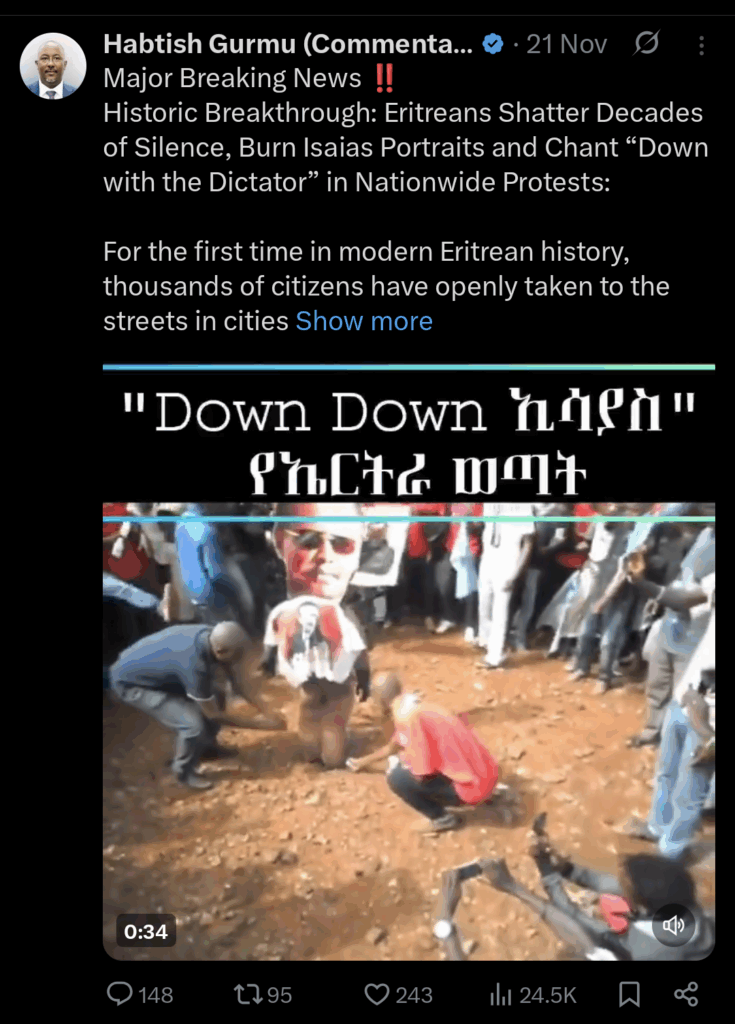
An “X” account alleged that Eritreans staged nationwide protests. The post claimed people burned portraits of President Isaias Afwerki and shouted “Down with the Dictator.”
Verdict
This claim is false. The circulating video does not depict a recent protest inside Eritrea. Instead, it originates from demonstrations held in 2016, nearly a decade ago, and has been misrepresented online as current evidence of nationwide unrest.
Investigation and Findings
On November 21, 2025, an “X” account named Habtish Gurmu posted a video. The post framed the footage as evidence of new unrest against the Eritrean regime. It claimed people were chanting anti-government slogans and waving flags (Refer to the screenshot below for verification).
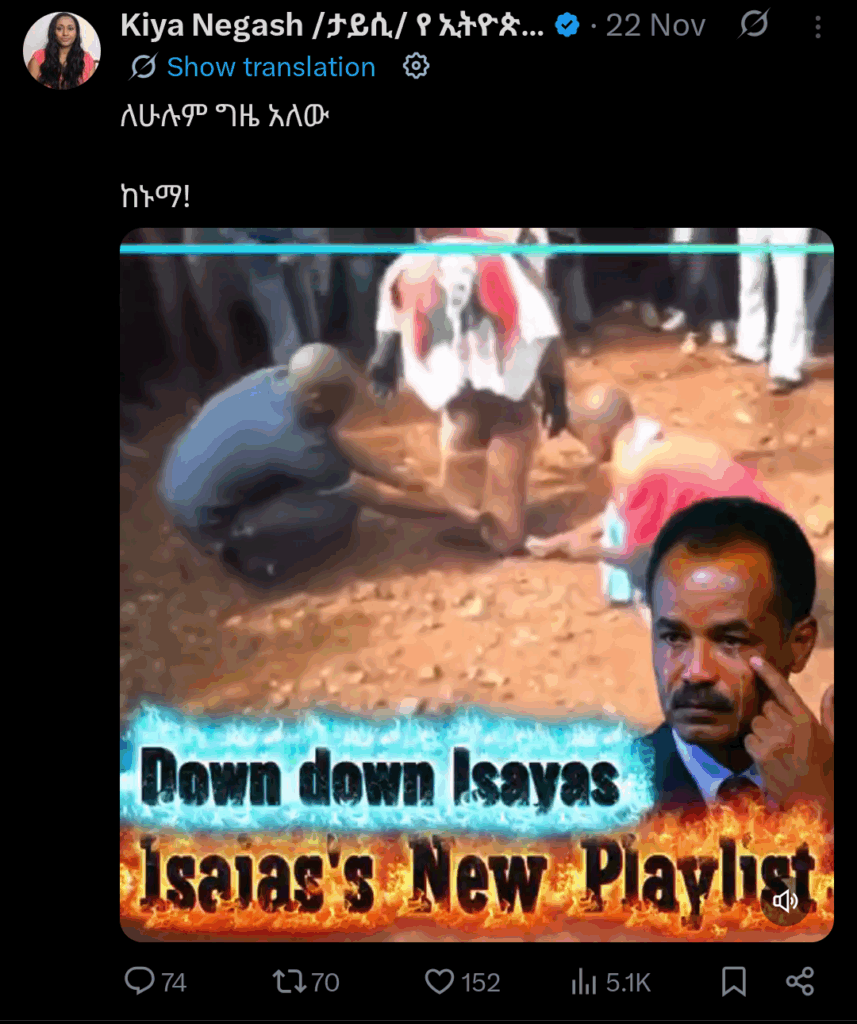
Another “X” account named Kiya Negash quickly reshared the same video, presenting it again as current. This repetition amplified the false narrative, making the footage appear more credible to unsuspecting viewers. As a result, the misleading claim spread further across the platform, reinforcing the illusion of ongoing unrest in Eritrea (See the visual evidence provided beneath).
MultiFact Check (MFC) investigated the footage using Google Lens and InVid tools. Our team traced the video back to its first appearance online in 2016.
On June 23, 2016, a Facebook page called Shiretube.com posted the video, crediting a user named Legesse Sbhat. Another Facebook account named Tigray Kuhulo Zeytmno uploaded the same footage on the same day. This evidence proves the video circulated nearly a decade ago (Review the supporting graphic below).
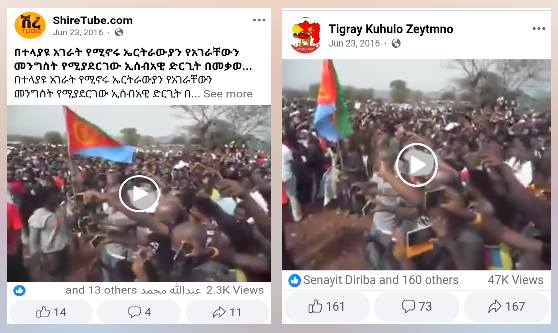
MFC’s investigation combined advanced digital verification tools with cross-platform archival research. This rigorous process confirmed the video’s original 2016 publication and decisively disproved claims of a recent protest, underscoring the reliability of evidence-based fact-checking.
Context
The exact location of the protest in the video posted with the claim under question remains uncertain. However, MFC’s team confirmed that the footage is not recent. International media outlets and human rights groups reported that Eritrean refugees and diaspora communities organized coordinated demonstrations on June 23, 2016. These protests took place in Ethiopia and several other countries, with participants denouncing alleged human rights abuses committed by the Eritrean government.
Further, Human Rights Watch and Amnesty International have consistently documented Eritrea’s long record of repression. Their reports highlight indefinite military conscription, severe restrictions on press freedom, and widespread mass migration. The Migration Policy Institute also noted that decades of authoritarian rule have driven thousands of Eritreans into exile. Refugees and asylum seekers often mobilize abroad because domestic dissent inside Eritrea faces immediate and harsh crackdowns.
Moreover, BBC has covered Eritrea’s political climate extensively, emphasizing the government’s intolerance of opposition. Likewise, Al Jazeera reported that diaspora protests frequently serve as a platform to amplify global awareness of abuses inside Eritrea. These demonstrations abroad reflect the frustration of exiled communities who cannot safely express dissent at home. They also illustrate how Eritrean voices rely on international spaces to challenge repression.
Therefore, this broader context explains why the video emerged internationally rather than from inside Eritrea itself. The footage represents diaspora-led activism, not nationwide protests within the country. By situating the video within Eritrea’s history of repression and exile-driven mobilization, the evidence underscores how misinformation can distort reality. It also highlights the importance of distinguishing between external demonstrations and internal political developments when evaluating viral claims.
Conclusion
No credible reports confirm mass protests inside Eritrea today. The footage was deliberately misrepresented to suggest new unrest, creating a false impression of political change. This case demonstrates how recycled content can be weaponized to mislead audiences and distort reality.
To stop the spread of such fabrications, both the public and reporters must adopt stricter verification practices. Audiences should question viral posts before sharing them, while journalists must cross-check footage with reliable archives and digital verification tools. Responsible reporting requires careful scrutiny of sources, especially when claims involve sensitive political contexts.
On that account, the claim of a nationwide protest inside Eritrea in 2025 is false. The video evidence originates from diaspora-led demonstrations in 2016, not from current events inside the country. After thorough examination of all available sources, MFC rated the claim as false.
By exposing recycled footage, fact-checking protects audiences from misinformation and strengthens trust in journalism. It also highlights how Eritrean dissent often occurs abroad, where freedom of expression is possible. Ultimately, vigilance against fabricated narratives ensures that public debate remains grounded in fact rather than manipulation.